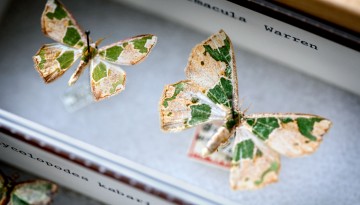
As director and head curator of the Cornell University Insect Collection, Corrie Moreau has numerous tasks on her to-do list, including one that could last her entire career: digitizing the collection’s 7 million specimens.
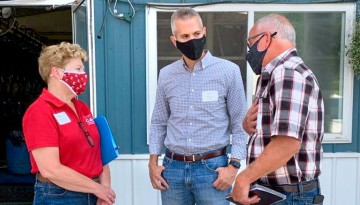
New York Congressman Anthony Brindisi met Aug. 10 with farmers and agricultural thought leaders – including Kathryn Boor ’80, the Ronald P. Lynch Dean of the College of Agriculture and Life Sciences – for a tour of E-Z Acres dairy farm in Homer.
Machine learning can assess the effectiveness of mathematical tools used to predict the movements of financial markets, according to new Cornell research.
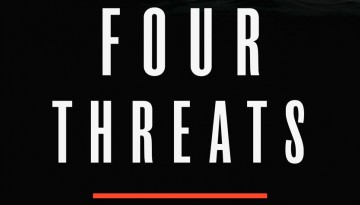
In “Four Threats,” a new book co-authored by government professor Suzanne Mettler, the authors not only assert that history repeats itself – they also identify the underlying causes of democracy destabilization.
Kate Manne, an associate professor of philosophy in the College of Arts and Sciences, tackles male entitlement in her second book, “Entitled: How Male Privilege Hurts Women,” released Aug. 11.
Weill Cornell Medicine’s Clinical and Translational Science Center has been awarded a two-year, $1.5 million NIH grant to investigate how social and biological factors help determine COVID-19 outcomes in New York City patients.
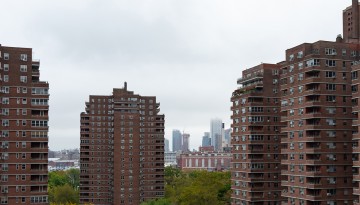
In flood-prone areas of the Hudson River valley in New York state, census areas with more white and affluent home owners tend to file a higher percentage of flood insurance claims than lower-income, minority residents, according to a new study.
New York City residents are four times more likely to choose a store where shoppers respect 6 feet of distancing than one where no one is social distancing, according to a Cornell experiment using 3D simulation.
A team of chemists, including Cornell’s Paul Houston, has unveiled the mechanics involved in the interplay between sunlight and molecules known as “roaming reactions,” which could improve climate change modeling.