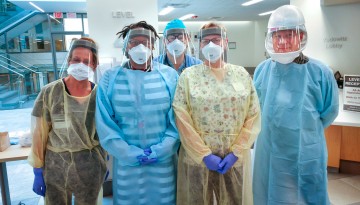
As of March 24, Cornell Health has moved to “pandemic operations,” based on the global public health landscape and recommendations from the Centers for Disease Control and Prevention.
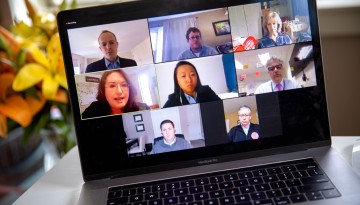
In a March 25 virtual forum sponsored by the Employee Assembly, senior university leaders updated staff on how the coronavirus pandemic is affecting jobs, facilities and community outreach.
Cornell will have connections to three of this year’s eight winners of 51 Pegasi b Fellowships in Planetary Astronomy. Two are coming to Ithaca for three years of postdoctoral work; another is a recent Cornell graduate.
The Cornell Online Learning Community’s annual event, held in person and virtually on March 4 in G10 Biotech, highlighted tools and possibilities for improving accessibility in online learning.
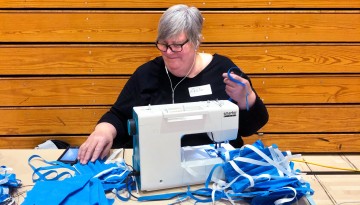
On Cornell’s Ithaca campus this week, in the midst of a semester interrupted by the COVID-19 pandemic, a basketball court in Bartels Hall stirred to life with a new, urgent mission and two dozen volunteers who began sewing surgical masks for Cayuga Medical Center.
Cornell astronomers have created five models representing key points from our planet’s evolution to use as spectral templates in the hunt for Earth-like planets.
Associate professor Adam Seth Litwin recently received a Fulbright U.S. Scholar Program grant, allowing him to serve as the J. William Fulbright Visiting Professor of Work and Organizational studies at the University of Sydney in Australia.