As the Faculty of Computing and Information Science celebrates its 20th year, Frank Rosenblatt’s prescient research into artificial intelligence underscores Cornell’s pivotal role in computing history.
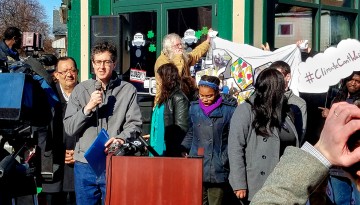
Sam Magavern, a public interest lawyer and community leader in his hometown of Buffalo, New York, is the new Cornell Buffalo Co-Lab Visiting Activist Scholar for the 2019-20 academic year.
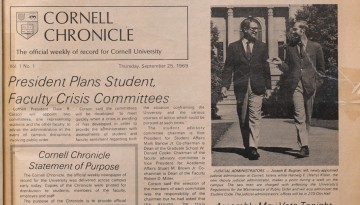
Arthur Brodeur ’58, the first editor of the Cornell Chronicle, reflects on the Chronicle’s earliest days, including its inaugural edition on Sept. 25, 1969. Here’s a look back, on the Chronicle’s 50th anniversary.
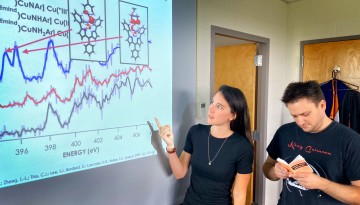
A collaboration between researchers from Cornell, Harvard, Stanford and the SLAC National Accelerator Laboratory has resulted in a reactive copper-nitrene catalyst that pries apart carbon-hydrogen bonds and transforms them into carbon-nitrogen bonds, a crucial building block for chemical synthesis.
Silvia Ferrari, the John Brancaccio Professor of Mechanical and Aerospace Engineering, has been awarded a grant to study the brains of moths with the goal of improving drone flight.
Anthony Jack, assistant professor of education at the Harvard Graduate School of Education, will address diversity at elite institutions in a lecture Oct. 3 in the Biotechnology Building, Room G10.
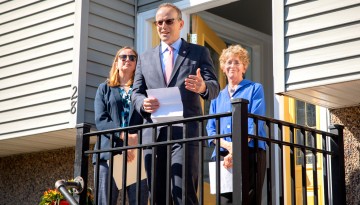
Cornell University has pledged continued support of the Community Housing Development Fund, a joint effort of Tompkins County, the city of Ithaca and Cornell.