Chief of Police Kathy Zoner joined 10 other law enforcement officers, district attorneys, victim advocates and college administrators in a roundtable discussion of sexual assaults on college campuses, June 23 in Washington, DC.
To determine effective tobacco warning labels, five Cornell faculty members will receive a five-year, $3 million federal grant to examine how anti-smoking messages can affect youth, and low-income and low-education groups.
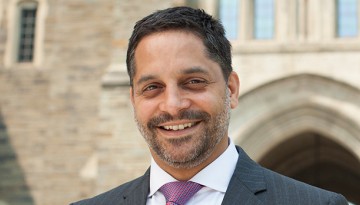
Eduardo Peñalver begins his term as the Allan R. Tessler Dean of Cornell Law School – the school's 16th dean and the first Latino dean of an Ivy League law school.
Testifying in Washington before the U.S. House of Representatives, professor Jonathan Lunine and Purdue President Mitch Daniels urged lawmakers to send astronauts to Mars.
Cornell law professor Jens Ohlin and U.S. Rep. Chris Gibson, an alumnus serving in the U.S. Congress after a long military career, jointly argued June 9 for fundamental changes in how America goes to war.
After 18 months of deliberation, the Committee on Human Spaceflight – co-led by a Cornell professor – issued a report June 4 on whether Earth-bound humans should continue exploring space. The conclusion: Let’s go red.
Fourteen Cornell faculty members are contributing columns to The Hill, a widely read policy website in Washington, D.C. Several columns have already appeared, offering faculty an opportunity to influence government decision makers.