An art installation in Columbus, Indiana, created by two Cornell AAP professors, highlights connections among places around the world named for Christopher Columbus.
BCTR's Residential Child Care Project confirmed 79 fatalities nationally over 26 years resulting from physical and mechanical restraints of children living in out-of-home care settings.
New research from the College of Engineering lays out in detail why ranked-choice voting, combined with multi-member legislative districts, promotes fair representation, particularly when it comes to blunting the practice of gerrymandering.
Despite the pandemic, Cornell students successfully navigated the process of applying to medical and law schools and are headed to some of the country’s top professional schools this fall.
As the U.S. withdrawal from Afghanistan unfolded, two events kept pace brought Afghan and congressional national security experts to the campus conversation.
The newly launched Cornell Jeb E. Brooks School of Public Policy will help shape a better world, university leaders and the school’s inaugural dean said at a Sept. 15 reception in Martha Van Rensselaer Hall.
Mitigating abuses of encrypted social media communication, on outlets such as WhatsApp and Signal, while ensuring user privacy is the focus of a five-year, $3 million NSF grant to a multidisciplinary Cornell research team.
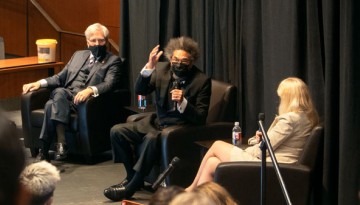
Scholars Cornel West and Robert P. George discussed “Truth-Seeking, Democracy, and Freedom of Thought and Expression” Sept. 9 in the fourth meeting of Civil Discourse: The Peter ’69 and Marilyn ’69 Coors Conversation Series.
The Technology and Law Colloquium – a hybrid Cornell University course and public lecture series – returns this semester with talks from 13 leading scholars who study the legal and ethical questions surrounding technology’s impact in areas like privacy, sex and gender, data collection, and policing.