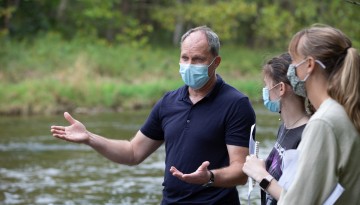
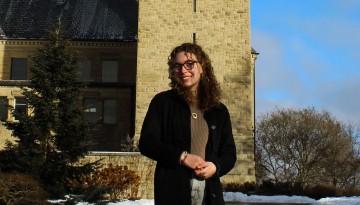
Instructors Marc Goebel and Kira Treibergs work to ensure that students in Introductory Field Biology (NTRES 2100) have a collaborative learning experience. Student teams build confidence through collaborating on field research and learning to read the landscape.
Biologist Alex Flecker and computer scientist Carla Gomes co-led a project that employed AI and around 40 researchers in an attempt to determine optimal placement of around 350 hydropower dams in the Amazon river basin.
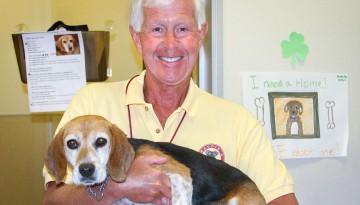
Thanks to a new $12.1 million grant from the Dave & Cheryl Duffield Foundation, the College of Veterinary Medicine is launching a new institute focused on companion animal behavior that will serve as a one-of-a-kind resource for veterinarians and pet owners nationwide; The Duffield Institute for Animal Behavior.
Scientists have uncovered a set of neurons in fruit flies that shut down in cold temperatures and slow reproduction, a system conserved in many insects, including mosquitoes, which could provide a target for pest control.
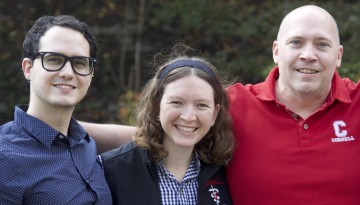
Assistant professors Pamela Chang, Antonio Fernandez-Ruiz, Daniel Halpern-Leistner and Peter McMahon have won 2022 Sloan Research Fellowships from the Alfred P. Sloan Foundation.
Twenty-six students with businesses ranging from drinking water treatment to alternative medicine to kitchen robots, received fellowships to work on their businesses this summer.
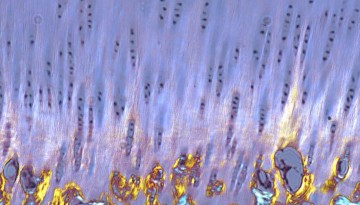
Four Cornell faculty members from three different colleges received the 2022 Kappa Delta Ann Doner Vaughn Award for their collaborative research on the mechanics and composition of articular cartilage and its relevance to disease.
Though Glenn Morgan Parker '25 shared what it was like to take an online course as a Precollege student, thanks to the Atkinson scholarship, and how it helped prepare her for her first year at Cornell.