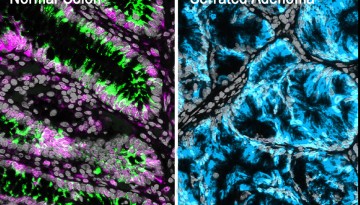
Research led by Weill Cornell Medicine provides new evidence that most colorectal cancers begin with the loss of intestinal stem cells, even before cancer-causing genetic alterations appear.
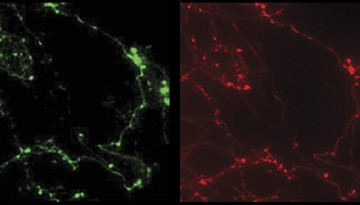
Researchers have developed and tested a high-resolution sensor for tracking the real-time dynamics of adenosine triphosphate levels in cells and within subcellular compartments.
More than 300 expected graduates in received their degrees from Weill Cornell Medicine during the institution’s annual commencement ceremony May 16 at Carnegie Hall.
Dr. Myles Wolf will lead the institutions’ largest clinical and academic department, overseeing 16 divisions and nearly 2,250 physicians and scientists.
Joan Klein Jacobs ’54, a global philanthropist who believed strongly in the power of education and the arts to transform lives, died May 6 in San Diego. She was 91.
Researchers from Cornell Tech, Cornell and Stanford University found that, despite their ability to display empathy, conversational agents such as Siri do poorly compared to humans when interpreting and exploring a user’s experience.
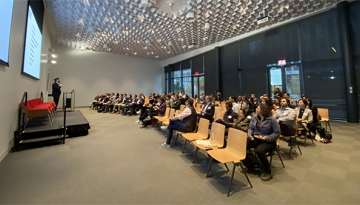
Big Red Ventures (BRV), Cornell University’s early-stage venture capital fund run by MBAs and other graduate students, presented its portfolio and announced a new investment during the Annual Meeting on April 18 at Cornell Tech.
Inulin, a type of fiber found in certain plant-based foods and fiber supplements, causes inflammation in the gut and exacerbates inflammatory bowel disease in a preclinical model, according to a new study.