Temperature variability reduces nesting success

Cold snaps and heat waves associated with climate change lead to more deadly nest failures for songbirds, new Cornell research has found.

With unprecedented flares, stellar corpse shows signs of life

After a distant star’s explosive death, a black hole or neutron star was the likely source of repeated energetic flares observed over several months, something astronomers had never seen before, a Cornell-led team reported Nov. 15 in Nature.

Einaudi fellowships support students learning uncommon languages

Applications are open for Rare and Distinctive Language Fellowships, which offer students intensive summer study in modern languages that are not commonly taught, including Zulu, Finnish, Yiddish, Sinhala, Tibetan and Burmese.

Absorbable scaffold beats angioplasty for lower-leg artery disease

In patients with severe artery blockage in the lower leg, an artery-supporting device called a resorbable scaffold is superior to angioplasty, according to the results of a large international clinical trial co-led by researchers at Weill Cornell Medicine and NewYork-Presbyterian.

Banerjee named Mellon Fellow in diversity network

A consortium of 13 research institutions, including Cornell, received a $1.5 million grant from The Andrew W. Mellon Foundation to launch the Ivy+ Mellon Leadership Fellows program this fall.

Louis Hand, pioneer of high-energy physics, dies at 90

Louis Hand, professor emeritus of physics, who dedicated more than 40 years to the Cornell community as a professor in the Department of Physics, in the College of Arts and Sciences, died Oct. 30. He was 90.

Employee Excellence awards honor staff achievements

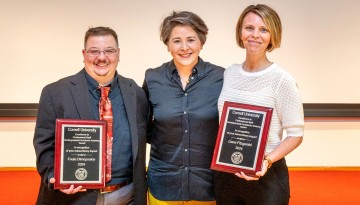
Seventeen individuals and three teams of Cornell employees received President's Awards for Employee Excellence in seven categories, highlighting the achievements of staff and faculty who excel in their roles.

Glasses use sonar, AI to interpret upper body poses in 3D

Throughout history, sonar’s distinctive “ping” has been used to map oceans, spot enemy submarines and find sunken ships. Today, a variation of that technology – in miniature form, developed by Cornell researchers – is proving a game-changer in wearable body-sensing technology.

Undergrad helps Ithaca homes switch to clean energy

With an Ithaca-based nonprofit, Kristinko Mato ’24 is working to install efficient heat pumps in units rented by low- and moderate-income tenants, reducing costs and emissions, and improving air quality.