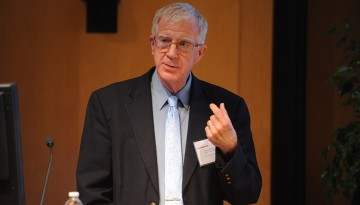
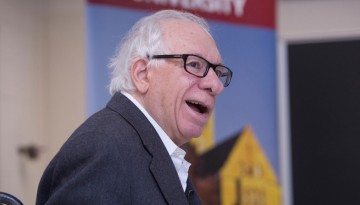
Scientists from around the world gathered June 22 to honor the career of Professor Michael Shuler, whose work in modeling biological systems continues to revolutionize the field of bioengineering and change the way pharmaceutical drugs are developed.
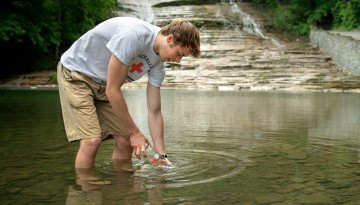
Ruth Richardson, associate professor of civil and environmental engineering, this summer is testing a water-monitoring system that could cut the time state swim areas are closed from 30 hours to 90 minutes.
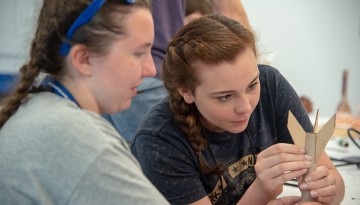
More than 500 middle and high school students from across New York gathered at Cornell’s Ithaca campus June 26-28 to participate in workshops taught by Cornell faculty, staff and graduate students during the annual 4-H Career Explorations conference.
The last data release and final official survey paper from the Arecibo Legacy Fast ALFA survey, a 13-year project led by Cornell astronomers, has just been published.
NASA has announced it will award the Distinguished Public Service Medal, its highest honor, to astronomer Yervant Terzian, the Tisch Distinguished Professor Emeritus.
Meredith Silberstein, assistant professor in the Department of Mechanical and Aerospace Engineering, will receive $150,000 a year over the next five years through a Department of Energy early-career program.
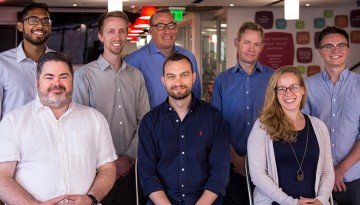
Doctoral students in Cornell Engineering’s Commercialization Fellowship are developing tools to compress laser pulses, separate blood plasma and 3D print living tissue.
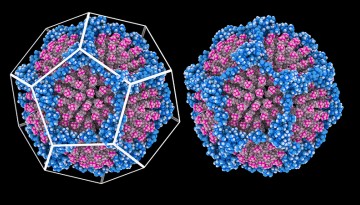
A cross-campus collaboration led by materials science professor Uli Wiesner results in visual confirmation of 12-sided, nanoscale cage structures, which could have medical diagnostic and therapeutic applications.