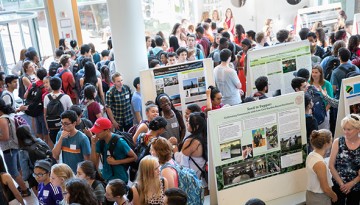
About 30 students from the Cornell Commitment office – Meinig scholars, Rawlings research scholars and Cornell Tradition fellows – presented posters and panel discussions Sept. 27.
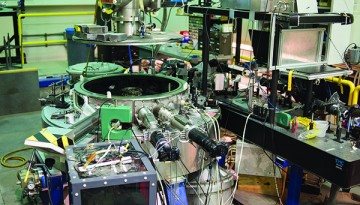
The Laboratory of Plasma Studies received a $15 million grant from the National Nuclear Security Administration and celebrates its 50th anniversary with a symposium Oct. 6-7.
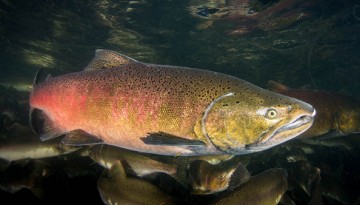
Advanced pop-off satellite tags developed by Cornell researchers and attached to the king salmon in Lake Ontario map the movements and feeding behavior in of the valuable fish.
The Cornell Center for Materials Research has been approved for a six-year, $23.2 million extension of funding from the National Science Foundation to continue its mission of research, education and outreach.
Nine faculty-led teams conducting research with undergraduate students have received Undergraduate Engaged Research Programs grants, administered by Engaged Cornell.
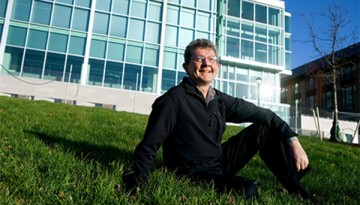
Physicist Séamus Davis has received a $2 million, five-year grant to explore new ways to study “quantum materials” like superconductors, superfluids and whatever comes next.
Cornell researchers have discovered that tiger beetles use their antennae to mechanically sense their environments and avoid obstacles while running at blinding speeds.
A revolutionary instrument that will expedite the discovery of new, artificial forms of matter will be funded by a $4.13 million gift from the Gordon and Betty Moore Foundation.
Cornell researchers have peered into the complex network of receptors that give bacteria the ability to sense their environment and respond to chemical changes as small as 1 part in 1,000.