Study participants who watched scenes from popular movies showed emotion plays a larger role than previously understood in establishing event boundaries that help structure attention and memory.
A research project collecting records of freedom-seeking enslaved people in the pre-Civil War U.S. came to a halt when researchers received a stop-work order from the National Endowment for the Humanities in early May.
For decades, researchers searched for a single “thermosensor”—a biological thermometer buried deep in the plant’s molecular machinery. But a new theory, led by Avilash Singh Yadav, postdoctoral associate at the Weill Institute for Cell and Molecular Biology and the Cornell College of Agriculture and Life Sciences, is flipping that idea on its head.
Cornell researchers have identified an antibiotic, rifampin, that is 99.9% effective against Salmonella Typhi, the bacterium that causes typhoid fever.
A Cornell research team has employed a variation of a theory first used to predict the collective actions of electrons in quantum mechanical systems to a much taller, human system – the National Basketball Association.
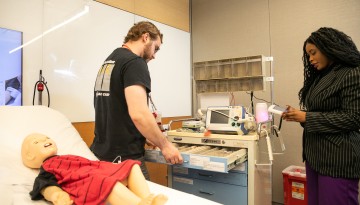
Cornell Tech researchers unveiled a robot that helps emergency room teams locate life-saving supplies faster, revealing how design can shape collaboration under pressure.
When cats get sick with H5N1 avian influenza, they get severely ill, with up to 70% of affected cats dying, but little is known about how the virus spreads in cats.