Using machine learning technology, a new study has identified three distinct profiles describing social and economic factors that are associated with a higher risk of suicide.
The Roper Center for Public Opinion Research has announced its 2025 student fellows. This year’s cohort includes the W.E.B. Du Bois Fellow and three Kohut Fellows. These emerging scholars will advance data-driven research by contributing original scholarly work that uses Roper iPoll’s extensive survey archive.
Cornell researchers are working to understand how robots can assist humans in dangerous and physically challenging environments, but the project, which is funded by the U.S. Department of Defense, has been halted by a stop-work order.
Cornell researchers have found the developers of large language models and the educators who use them have different ideas about the potential harms they may cause, a finding that researchers say underscores the need for educators to be more involved in the tools’ development.
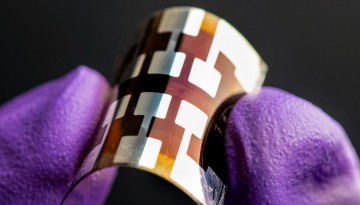
By finding the atomic equivalent of a perfect handshake between two types of perovskite, researchers at Cornell have built solar cells that are not only high-performing, but exceptionally durable.
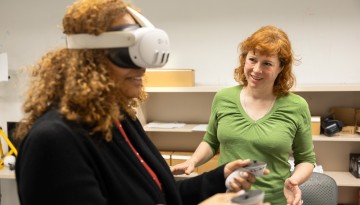
In between classes and extracurriculars, students showcasing their tech-based projects in the 2025 annual Bits On Our Minds could have been seeing friends or catching up on sleep. Instead they were using their free time to brainstorm, experiment, code and create.