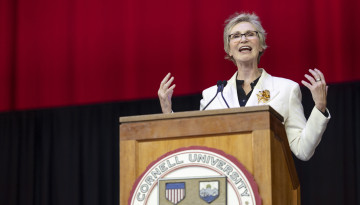
In her Senior Convocation address on May 21 in Barton Hall, Jane Lynch, MFA ’84, told the Class of 2026 to do their best to overcome their fears, don’t subscribe to cultural memes, and be kind and generous.
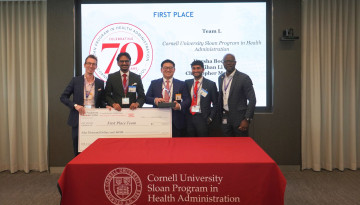
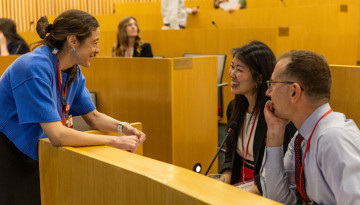
A team from Cornell University’s Sloan Program in Health Administration earned first place at the Cornell Sloan Program in Health Administration National Case Competition hosted by the University of Texas MD Anderson Cancer Center.
In his new book, Art faculty Nicholas Muellner looks for ways to move forward in life and creative practice while surrounded by the crises and complexities of our current cultural moment.
Large numbers of college students are now using artificial intelligence to complete – and cheat on – their assignments, suggesting that colleges and universities need to change how they are evaluating students.
Polarization is often created by political elites aiming to gain popularity, but it can also be caused by social conflicts rooted in extreme inequalities, according to a new book about Latin America politics co-authored by two Cornell professors.
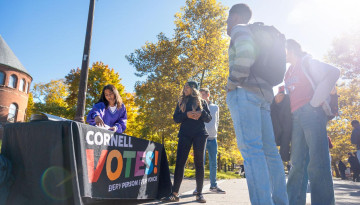
Amid concern about democratic backsliding globally, the center will mobilize scholars to strengthen democracy through rigorous research, democratic education and public engagement.
The buildout of a 10,000-square-foot quantum research facility at Cornell is advancing with a new $10 million investment from the Cornell Duffield College of Engineering, with an additional $3.5 million announced to support collaborative research projects.
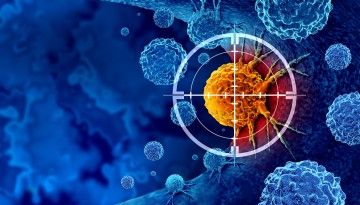
Targeting tumor-specific inflammatory processes in colorectal cancer could enhance the efficacy of some anticancer therapies and prevent drug resistance, Weill Cornell researchers have found.
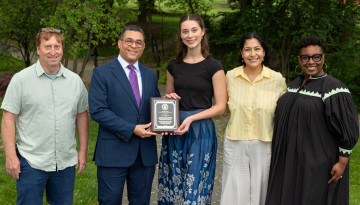
For her volunteer outreach encouraging local children to learn about physics and reading, Abra Geiger ’26 has won the 2026 University Relations Campus-Community Leadership Award.