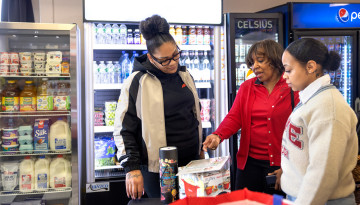
CCE Erie County encourages corner stores in Buffalo’s food deserts to stock fresh fruits, vegetables and other nutritious options and educates residents on how to take care of their health.
Major League Baseball is instituting a major change this season, and it has inspired Cornell researchers to study how stakeholders are integrating the Automated Ball-Strike System, or ABS, into baseball’s sacred gameplay.
Emily Bernhardt, Ph.D. ’01, the James B. Duke Professor of Biogeochemistry at Duke University, will join Cornell as the Francis J. DiSalvo Director of the Cornell Atkinson Center for Sustainability on Sept. 1.
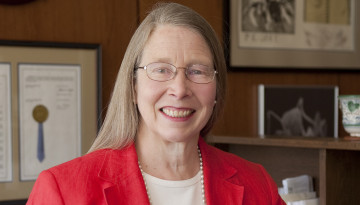
Susan Henry, former dean of the College of Agriculture and Life Sciences and a molecular geneticist whose breakthroughs in understanding cell metabolism contributed to advances in human pharmaceuticals, died March 7 at age 79.
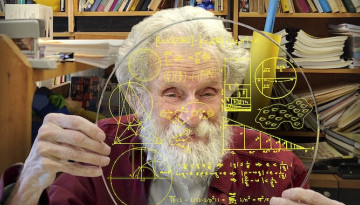
Cornell math professor Steven Strogatz appears in a new film, “Hunting Yellow Pigs,” that celebrates the Hampshire College Summer Studies in Mathematics (HCSSiM) and its unconventional approach to math education. The Department of Mathematics in the College of Arts and Sciences will host a screening with filmmaker Ming-I Huang on March 24 at 4 p.m. in Schwarz Auditorium, room 201 in Rockefeller Hall.
A new task force report seeks to reduce the prevalence of sexual assault among undergraduates by targeting the social conditions that enable assault, while also increasing education and communication to promote a safe and healthy campus.
A Cornell statistics expert has come up with a method he believes can boost statistical power and significantly reduce bias – vital for research involving outcomes that differ by socioeconomics, race, sex and other variables.
Cornell-led research argues that food safety regulations should set evidence-based targets for food that is sufficiently safe rather than aiming for zero risk, which is neither achievable nor desirable.
The Cornell College of Veterinary Medicine (CVM) will welcome community members of all ages to its annual CVM Open House on Saturday, April 11, from 9 a.m. to 3 p.m. The event is free and open to the public.
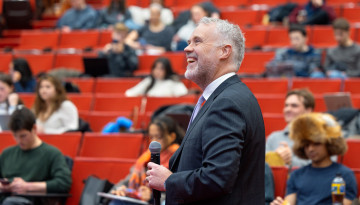
A new class, Disagreement, co-developed by Arts and Sciences Dean Peter John Loewen, helps students learn how to confront and move through disagreements at work, at home, in their communities and in society.
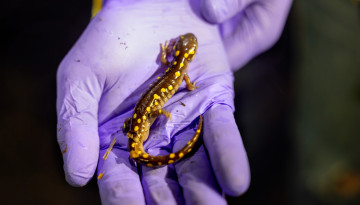
Led by two Cornell graduate students, more than 300 volunteers are heading out into the rain on warm spring nights to help migrating salamanders and frogs.