New event asks the community to decrease technology use, increase face-to-face interaction and consider that every AI chat, doomscroll and text message has a water, energy and carbon footprint.
Cornell and global leaders will come together at Climate Week NYC Sept. 20-27 to discuss some of the world’s most pressing sustainability challenges, including harnessing AI’s power while mitigating its negative impacts.
Cornell researchers have used artificial intelligence to uncover a previously unknown way cells control how proteins move inside them, a process essential for growth, communication and movement, and one that is often disrupted in cancer.
Rakesh Khurana ’89 will discuss why public trust in higher education has declined – and how universities and colleges can respond – when he delivers this year’s Milton R. Konvitz Memorial Lectureship in American Ideals.
A field of tomato plants during the 2026 Aurora Farm Field Day at Cornell’s Musgrave Research Farm is testing whether a living sensor can reveal nitrogen stress under unpredictable growing conditions.
Doctoral student Sylvana Ross and a team of Cincinnati youths spent their summer studying city-dwelling insects, amassing data that can inform decisions that support healthy green spaces.
Cornell students are gaining new opportunities to extend classroom learning beyond campus through the latest round of Engaged Opportunity Grants from the Einhorn Center for Community Engagement.
The five funded projects bring…
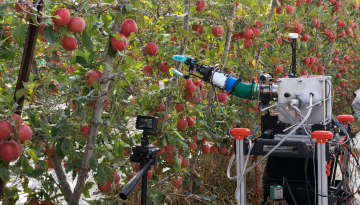
A Cornell-led research project is developing robots that can perform labor-intensive orchard operations; it’s supported by a four-year, $7.5 million grant from the U.S. Department of Agriculture’s Specialty Crop Research Initiative.
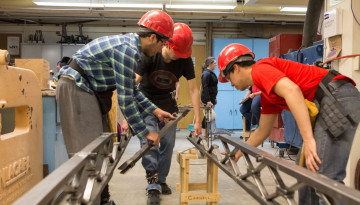
A new National Science Foundation grant awarded to the Cornell Duffield College of Engineering aims to develop a more systematic approach to teaching teamwork by helping instructors identify what they want students to learn from team experiences.