An update from the Office of the Assemblies, including brief reports from the Student Assembly, Graduate and Professional Student Assembly, Employee Assembly and University Assembly.
Events on campus this week include sustainability expert/graduate student Annie Leonard with 'The Story of Stuff;' the annual Pao Bhangra show; films about bees and AIDS; the 22nd Cornell Jazz Festival and a climate readiness conference.
Ritter, professor of government and vice provost at the University of Texas, will begin her new appointment Aug. 1. A third-generation Cornellian, she is the college’s first woman dean and first externally hired dean.
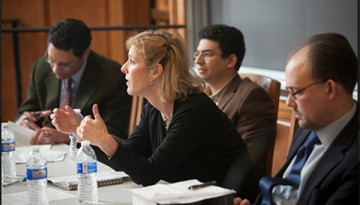
A panel of eight Cornell-affiliated education advocates stressed the importance of reform during a lively discussion on the future of education at the Cornell Club in Manhattan April 3.
At an April 6 panel discussion, Native American and Filipino artists said that hip-hop provides an outlet for advocacy and an effective way to keep indigenous culture and values alive.
Expansion of Arctic vegetation due to climate change has probably been underestimated, and increasing tree and shrub cover will accelerate climate change and possible adverse effects on wildlife.
J.P. Sniadecki, who joins the Department of Performing and Media Arts as an assistant professor in the fall, brings an anthropological perspective to cinematic art.
Alumni, students and faculty are invited to the annual Entrepreneurship@Cornell Celebration, April 18-19, for the two-day conference on entrepreneurship.
Tom Wilber and Seamus McGraw offered their perspectives as writers tracking the issue at regional, national, and international levels at an April 4 public forum on campus.
The Cornell eRulemaking Initiative has partnered with the U.S. Department of Health and Human Services to solicit public input for updating the Federal Health IT strategic plan.
Faculty and staff members are asked to volunteer for Slope Day, May. Four-hour and two-hour shifts are available on the final day of classes to help those attending the event be safe.