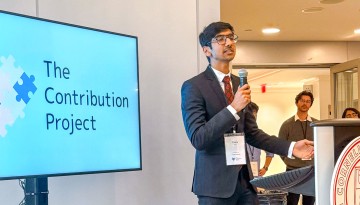
Students from Cornell, Binghamton and Stony Brook universities came together to celebrate the contributions they made to improve local, regional and international communities during a showcase event on April 19 in the College of Human Ecology’s Commons.
Cornell faculty and husband-and-wife creative team Mendi and Keith Obadike have worked for decades across music, text, and visual art to explore complex histories and social tensions. The resulting pieces invite the audience into a conversation with both the artists and their material.
More than 400 Cornell employees and community members attended the fifth annual Inclusive Excellence Summit, gathering virtually and in-person to show their commitment to diversity, equity and inclusion.
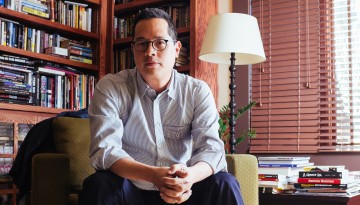
Award-winning writer and cultural organizer Jeff Chang returned to Cornell on April 16 to deliver a keynote presentation and workshop for nearly 60 professionals from higher education institutions nationwide during the 2024 IVY Plus EEO/AA Annual Meeting.
Germicidal ultraviolet light is effective at killing a damaging fungus that infects table beets, adding an important organic tool to fight the growing problem of fungicide resistance, according to a new Cornell study.
Faculty and students joined community members, nonprofit leaders and Cayuga Health System representatives April 12-13 to explore a new vision for The Shops at Ithaca Mall focused on health equity.
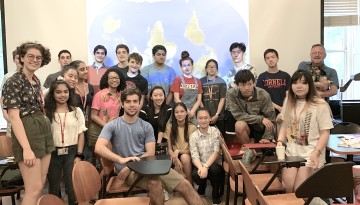
GOVT 1817 Making Sense of World Politics will be taught online this summer by Dr. Chip Gagnon from June 24-July 12. The three-credit class will examine ways to think critically about global politics and develop informed ways of discussing them.
A report from the ILR School’s Climate Justice Institute finds significant issues in New York state’s solar construction workforce, including transience, uncertain benefits and racial pay disparities.
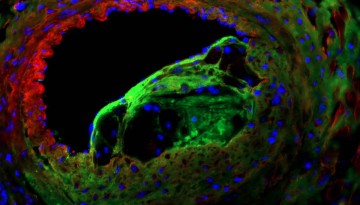
Weill Cornell Medicine investigators have uncovered a way to unleash in blood vessels the protective effects of a type of fat-related molecule known as a sphingolipid, suggesting a promising new strategy for the treatment of coronary artery disease.
In the season finale of the Inclusive Excellence Podcast, Erin Sember-Chase and Toral Patel are joined by Cal Walker, a retiree of Cornell and longstanding citizen of Ithaca for nearly 50 years. Walker shares his journey from Civil Rights-era Alabama to New York, arriving in Ithaca in 1977 and wasting no time to make a difference in the community.