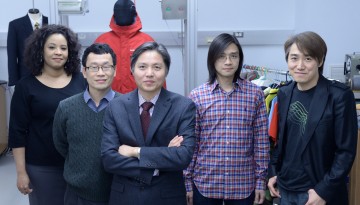
These clothes soon may be all the rave: Fiber science and physics students have teamed to create fashionable “smart” garments with vivid, luminescent panels that pulse to music.
First-year architecture students carry on more than a century of campus tradition March 27 with Dragon Day, an annual project honing the architects' skills in design, fabrication and teamwork.
About 57 years after Cornell opened, Willard Straight Hall opened its doors Nov. 18, 1925. The building, bustling with music, dance and club meetings, achieved instant success and a richer student social life unfolded.
Jenny Sabin talks about the April 26 panel discussion, "Seeing and Hearing at the Cutting Edge: The Time of Experience," part of Charter Day Weekend's Festival of Ideas and Imagination, April 24-27.
Cornell’s pioneering, engineering women – Kate Gleason, Nora Stanton Blatch and Olive Wetzel Dennis – advanced the science of their discipline beyond all expectation of their male peers.
“150 Years of Cornell Student Fashion” opens Feb. 2 in the Human Ecology Building. Part of the sesquicentennial celebration, the exhibit displays ensembles dating back to 1865.
Birth of chic: Blake Uretsky ’15 won a $30,000 Geoffrey Beene national scholarship from the YMA Fashion Scholarship Fund, for her design of maternity wear that monitors the vitals of expectant mothers.
Warming up to a brisk idea to save building energy, the U.S. Department of Energy has awarded Cornell researchers a $3 million grant to create new clothes that integrate "air-conditioning" into undergarments.
The newly constructed addition to the Cornell Law School’s Myron Taylor Hall exceeded its burden of proof: It’s now certified LEED Platinum by the U.S. Green Building Council. The Platinum certification is the second at Cornell.