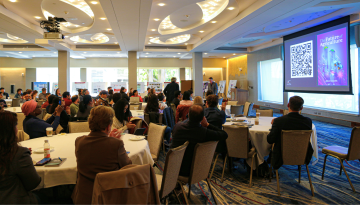
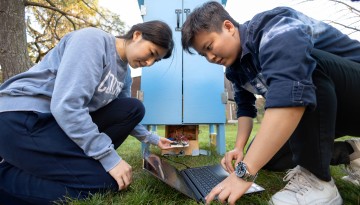
The Cornell Institute for Digital Agriculture (CIDA) convened its annual workshop on Oct. 21, 2025, at the Statler Hotel on the Cornell University campus. The day-long gathering featured project updates, networking, and a keynote exploring how artificial intelligence is reshaping food systems.
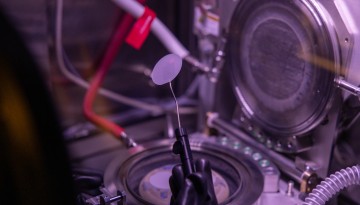
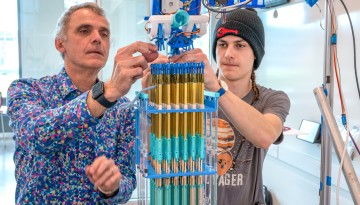
A custom-built, metal-organic chemical vapor deposition system in Duffield Hall will help forge new directions for nitride semiconductors, materials best known for enabling LEDs and 5G communications.
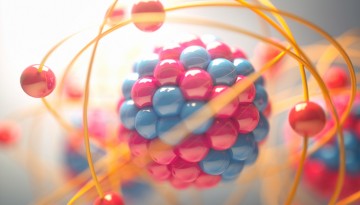
Using a Cornell-built instrument and Cornell-built high-speed detector, a team of researchers captured atomically thin materials responding to light with a dynamic twisting motion.
The 2025 Cornell Neurotech Mong Family Foundation Symposium, hosted jointly by Cornell Engineering and the College of Arts and Sciences, featured two leading researchers in neuroscience to explore how neural circuitry in the brain directs complex behaviors.
Through a new collaboration with the Einhorn Center, Cornell Engineering will ensure that every undergraduate student in the college participates in community-engaged learning experiences that apply their technical skills to real-world community challenges.
Researchers used advanced data analytics to create a state-by-state look at that environmental impact of the AI boom and how to make the computing infrastructure that supports it more sustainable.
Huili Grace Xing, the William L. Quackenbush Professor of Electrical and Computer Engineering and of Materials Science and Engineering, is the recipient of the 2025 University Research Award in Technology from the Semiconductor Industry Association and Semiconductor Research Corporation.
A multicollege team has developed a prototype of a knitting machine that creates solid, knitted shapes, adding stitches in any direction so users can construct a wide variety of shapes and add stiffness to different parts of the object.
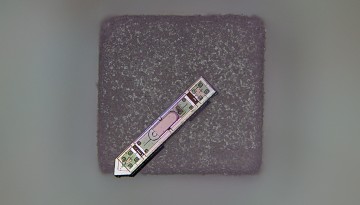
Cornell researchers and collaborators have developed a neural implant so small that it can rest on a grain of salt, yet it can wirelessly transmit brain activity data in a living animal for more than a year.