Everett Donald Markwardt, M.S. ’51, a leader in reforms that modernized agricultural outreach and support across the Northeast, has died at the age of 100.
Cornell is co-leading a five-year, $12.5 million grant from the National Science Foundation to form the IISAGE Biology Integration Institute aimed at identifying mechanisms and evolution of sex differences between females and males in aging.
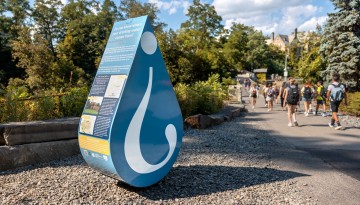
Turning on a faucet for a drink rarely elicits deep thoughts on how the water got there. But two new Water Resources Institute “water drops” are packed with a torrent of information.
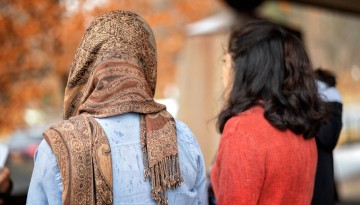
Nine Afghan undergraduates from Bangladesh-based Asian University for Women, who fled their country after the Taliban took control in August 2021, have been admitted as Cornell students with full financial aid.
A Cornell-led group of researchers has developed an online search method that employs natural language processing to identify terms that are semantically similar to those for cancer screening tests, but in colloquial language.
The movement involves not only re-establishing heritage foods, but also bolstering the systems that sustain them: irrigation and land access, for instance.
Cornell’s Society for the Humanities will kick off its 2022-23 theme of “Repair” with a community read of “The Gayogo̱hó꞉nǫɁ People in the Cayuga Lake Region. A Brief History” by Kurt Jordan, associate professor of anthropology in the College of Arts and Sciences.
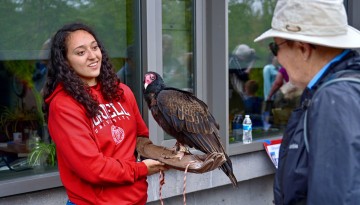
For the first time since 2019, the Cornell Lab of Ornithology’s free Migration Celebration – marking the biannual phenomenon of bird migration – is being held as an in-person event.
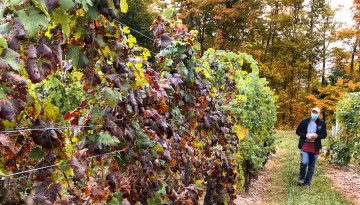
The New York State Department of Agriculture and Markets, in partnership with Cornell AgriTech, has launched a revitalized grapevine certification program to provide growers in New York and North America with clean, virus-tested plant material verified by the most stringent testing standards in the world.