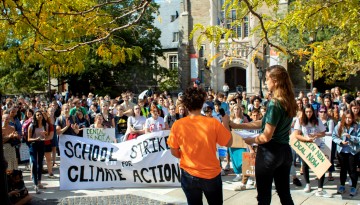
Cornell students participated in a weeklong kaleidoscope of climate change-awareness that involved strikes, symposia and meeting world leaders in New York City.
Researchers from every corner of Cornell are mobilizing to tackle one of the grand challenges of the modern era – migration – with a new initiative that launched Oct. 1.
Twenty-nine Cornell undergraduates spent their summers working and conducting research in communities across New York state as Cornell Cooperative Extension interns.
Cornell’s Community and Regional Development Institute hosts “From Zombies to Vacants to Sustainable Housing: Building Resilient Communities,” a symposium Oct. 23-24 on the Cornell campus.
By editing specialized genes into laboratory fruit flies, scientists have reconstructed evolution and instantly conferred in the flies the same toxin resistance enjoyed by monarch butterflies.
Science may be inching closer to thwarting obesity, heart disease and Type 2 diabetes, as Cornell biochemists have uncovered a key step in how the human body metabolizes sugar.
The second annual Intercampus Cancer Symposium, Oct. 11 at the Cornell College of Veterinary Medicine, will highlight the wide range of cancer research taking place at Cornell’s Ithaca campus and at Weill Cornell Medicine in New York City.
This year’s Innovative Teaching and Learning Award winners will give Cornell students a host of new opportunities and experiences, thanks to faculty grants ranging from $5,000 to $25,000.
New research finds that, under threat, plants can communicate with one another in the form of airborne chemicals known as volatile organic compounds, which transfer information.