eHub opened earlier this month in Kennedy Hall and houses the offices of Entrepreneurship at Cornell and Blackstone LaunchPad for use by students, faculty and staff interested in entrepreneurship.
For the first time, Cornell researchers report they have identified biological markers of chronic fatigue syndrome in gut bacteria and inflammatory microbial agents in the blood.
Faculty members Harold van Es, Carla Gomes and Joshua Woodard will present their innovative research at the intersection of computation, food and sustainability at the World Economic Forum June 26-28 in Tianjin, China.
A naturally produced chemical exacerbates infection by a common bacteria, rendering the infection significantly harder for the body to clear, according to new Cornell cross-campus research.
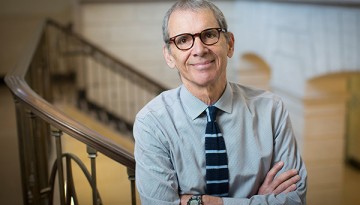
A faculty member since 1983, McLaughlin is senior associate director of the Dyson School. He will become Dyson's interim David J. Nolan Dean starting July 1, Provost Michael Kotlikoff announced.
The National Institutes of Health's National Institute of Biomedical Imaging and Bioengineering has awarded Cornell a four-year, $2.3 million grant to develop FeverPhone, which will diagnose six febrile diseases in the field.
Starting in the fall 2017 semester, Cornell University will offer a Master of Public Health degree with a focus on epidemiology, infectious disease, food systems and sustainability.
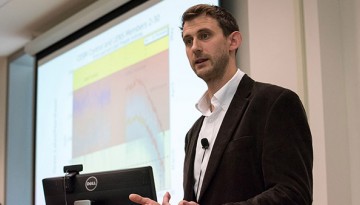
Toby Ault presented a Reunion Weekend lecture on extreme weather and its impacts on agriculture, held in conjunction with a Mann Library exhibit showcasing collaborations between the Cornell Climate Smart Farming Program and New York state farmers.
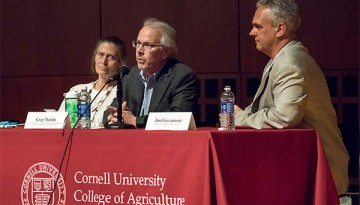
In the Liberty Hyde Bailey Lecture, held June 10 as part of Reunion Weekend at Call Auditorium, faculty members Greg Martin, Jim Giovannoni and Susan McCouch, Ph.D. ’90 celebrated their mentor, Cornell Professor Emeritus Steve Tanksley.