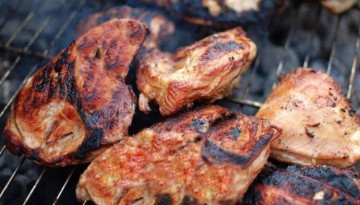
The Clintons, their daughter Chelsea, who toured the New York State Fair in nearby Syracuse. There they visited the Bakers' Chicken Coop eatery, specifically to savor a taste of the famous Cornell barbecued chicken. Robert Baker, Cornell professor of animal science, created the recipe.
Science educators at Cornell University's College of Agriculture and Life Sciences hope dog-lovers can sit-and-stay by their computers for six weeks. That's how long it takes to complete a new home-study course on canine genetics via the Internet.
Dog-walker's elbow, cowboy thumb, snowmobiler's back and miner's knee are among the nearly 150 conditions described in a new book, "Atlas of Occupational Markers on Human Remains," by Luigi Capasso, Kenneth A.R. Kennedy and Cynthia A. Wilczak.
An increasingly popular commercial corn, genetically engineered to produce a bacterial toxin to protect against corn pests, has an unwanted side effect: Its pollen kills monarch butterfly larvae in laboratory tests, according to a report by Cornell University researchers.
F. Sherwood Rowland, will inaugurate the Jill and Ken Iscol Distinguished Environmental Lectureship at Cornell April 20 and 21 with lectures on science and public policy.
A few bad actors among the more than 30,000 non-indigenous species in the United States cost $123 billion a year in economic losses, Cornell University ecologists estimate. "It doesn't take many trouble-makers to cause tremendous damage," Cornell ecologist David Pimentel.
George L. McNew, who was instrumental in bringing the Boyce Thompson Institute (BTI) for Plant Research, Inc., to its current site on the campus of Cornell University, died Oct. 30, in Las Cruces, N.M. He was 90.
A Cornell food science student has answered an age-old question that has puzzled collegians through the years: Dude, why is the cheese on this cold pizza translucent?
A simple change in cattle diets in the days before slaughter may reduce the risk of Escherichia coli (E. coli) infections in humans, U.S. Department of Agriculture (USDA) and Cornell University microbiologists have discovered.