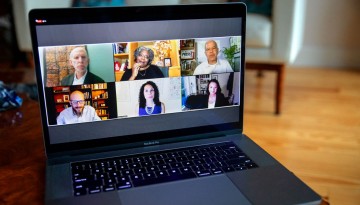
Four faculty experts kicked off the College of Arts and Sciences’ yearlong “Racism in America” webinar series with a Sept. 16 discussion about policing and incarceration.
There isn’t one unified Asian American vision of California, argues Christine Bacareza Balance, associate professor of Performing and Media Arts, in “California Dreaming,” a multi-genre collection she co-edited.
A rocky planet orbiting a white dwarf – a star in a phase after death – would present an excellent opportunity to search for molecules that signify life using the James Webb Space Telescope, Cornell researchers write in the Astrophysical Journal Letters.
The powerful new telescope being built for a high-elevation site in Chile by a consortium of U.S., German and Canadian academic institutions, led by Cornell, has a new name: the Fred Young Submillimeter Telescope.
As scientists prepare to study Martian soil for signs of life, a new worry emerges. Acidic fluids once on Mars’ surface may have destroyed biological evidence hidden within the planet’s iron-rich clays.
Cornell food scientists show in animal studies that a mother’s high-fat diet may lead to more sweet-taste receptors in taste buds resulting in poor feeding behavior, obesity in adulthood.
Around campus academic quads and residential areas, in the thick of autumn’s red and yellow leaves, soon there’ll be something green: a new tool-toting, solar power-generating trailer.
Twenty faculty members from eight colleges have been named Engaged Faculty Fellows, committed to advancing community-engaged learning and scholarship at Cornell and within their academic disciplines.
Scientists have detected signs of a frog listed extinct and not seen since 1968, using an innovative technique to locate declining and missing species in two regions of Brazil.