Cornell physicists have shrunk the technology of an optical trap, which uses light to suspend and manipulate molecules like DNA and proteins, onto a single chip.
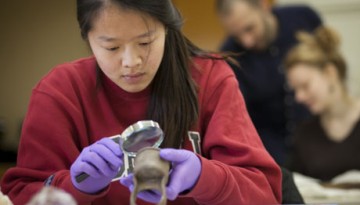
This “Rise and Fall of ‘Civilization’” class, taught by Professor Adam T. Smith, examines traditional archaeological topics, partly by looking at our current civilization and imagining the Cornell campus 1,000 years from now.
Douglas Rutzen ’87, president and CEO of the International Center for Not-for-Profit Law, will present, "Defending Civil Society and Peaceful Protest Around the World," April 29 at 4:30 p.m. in Lewis Auditorium, Goldwin Smith Hall.
A $3.8 million grant from the John Templeton Foundation will fund a new research project on hope and optimism, co-directed by Cornell philosophy professor Andrew Chignell.
In his Iscol lecture, land-mending advocate Luc Gnacadja warned that the worldwide problem of soil erosion contributes to poverty and hunger and threatens security and freedom.
Provost Kent Fuchs and Harry Greene, professor of ecology and evolutionary biology, and Chuck Feeney '56 have been elected to the American Academy of Arts and Sciences.
Using an airplane to detect greenhouse emissions emanating from freshly drilled shale gas wells in Pennsylvania’s Marcellus basin, Cornell and Purdue scientists have found that leaked methane is more of a problem than previously thought.
Cornell High Energy Synchrotron Source has received its requested National Science Foundation grant renewal of up to $100 million over five years, securing the national X-ray facility’s near-term future.