Empire AI, a $400 million effort to create a shared academic research computing facility, is set to advance dozens of ambitious, cross-disciplinary projects at Cornell.
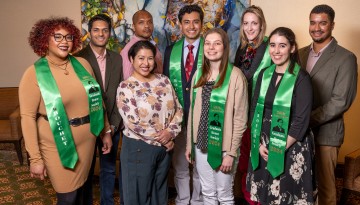
Eight doctoral candidates and two postdocs were inducted into the Cornell Chapter of the Bouchet Graduate Honor Society, which recognizes scholarly achievement and promotes diversity in doctoral education.
Nine students and recent graduates representing Cornell’s four contract colleges were selected to receive the 2024 State University of New York Chancellor’s Award for Student Excellence.
Gerald White, a professor emeritus of agricultural economics in the Charles H. Dyson School of Applied Economics and Management whose research supported fruit growers and winemakers in New York state and around the world, died April 14, 2023, in Ithaca.
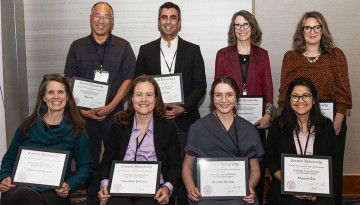
Thirteen Cornell faculty members have received Community-Engaged Practice and Innovation Awards from the Einhorn Center for Community Engagement. The awards recognize faculty who have recently developed community-engaged learning, leadership or research activities that create opportunities for students.
Cornell faculty members Ailong Ke, David Shmoys and Martin T. Wells have been elected fellows of the American Association for the Advancement of Science, the world’s largest general scientific society.
Doctoral student Ria Gualano gives people with disabilities a platform to express unseen aspects of their identities and experiences in an exhibition that opens April 25.
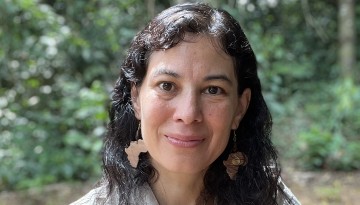
Doctoral candidate Ivonne Kienast received the 2024 Maribel Garcia Community Spirit Award from the Einhorn Center for Community Engagement for her commitment to wildlife conservation and education in Africa.