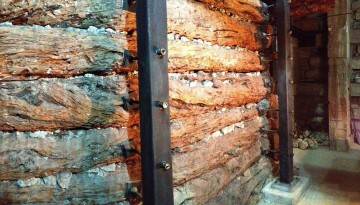
An interdisciplinary collaboration used tree ring and isotope records to pinpoint a likely culprit for the collapse of the Hittite Empire: three straight years of severe drought in an already dry period.
In her new book, “Unknowing and the Everyday: Sufism and Knowledge in Iran,” Seema Golestaneh explores the ways the Sufi mystical experience – particularly the role of mystical knowledge – is shaping contemporary life in Iran.
An investigation at Tirez lagoon in central Spain, analogous to the surface of Mars, concludes that if life existed when the planet had liquid water on its surface, desiccation would not have necessarily implied that life disappeared for good.
A new posthumous memoir by Isaac Kramnick, the renowned scholar of political thought and history who served on the Cornell faculty for 45 years, traces his life from birth into an unstable family and years in the child welfare system to his undergraduate days at Harvard University.
Conferred by the English department chairs at Cornell, Princeton University and Yale University, the Nathan Award is administered by Cornell’s Department of Literatures in English, in the College of Arts and Sciences.
Founded in 1982 and celebrating 40 years, Cornell Academics and Professors Emeriti represents a large community of retired academics and faculty that continue to make significant contributions to university life.