Five Cornell faculty members have been elected fellows of the American Association for the Advancement of Science, the world’s largest general scientific society.
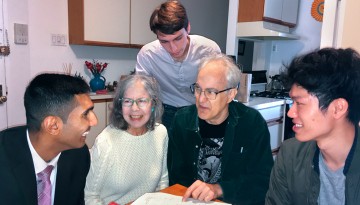
Research co-authored by assistant professor of history Stephen Vider reveals that community-based clinicians play a key role in reshaping mental health care for LGBT people and broader attitudes about sexuality and gender.
A team led by physics professors Itai Cohen and Paul McEuen is using the binding power of magnets to design self-assembling systems that potentially can be created in nanoscale form.
Events at Cornell include the 32nd annual Traditional Thanksgiving Feast; “Queen of Carthage,” an opera-oratorio by Ellie Cherry ’19; a lecture on birding and nature appreciation, and Mini Locally Grown Dance concerts.
Tom Goldstone ’94 says his College of Arts and Sciences education has helped him make sense of the world. That’s what he does every day at CNN as executive producer of “Fareed Zakaria GPS,” a show whose mission – and tagline – is exactly that.
University leaders and trustees on Nov. 18 honored 15 individuals and three teams with President’s Awards for Employee Excellence, and the inaugural Trustee Award for Excellence.