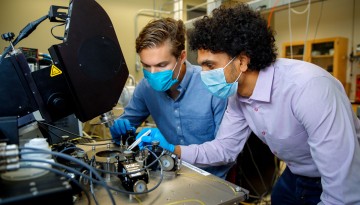
Students and faculty in the College of Engineering are leveraging the university’s robust entrepreneurial ecosystem to launch a variety of tech startups.
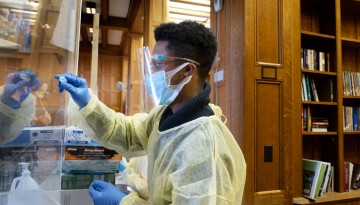
At Cornell, committed leaders, expert faculty, trained staff and student hires have worked tirelessly behind the scenes to create a winning strategy to reactivate campus and keep the community safe from COVID-19.
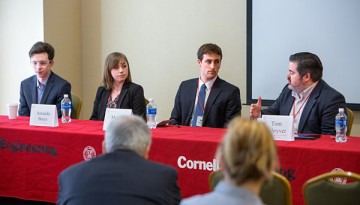
Student startup accelerator eLab has selected 21 teams of student-entrepreneurs for its 2020-21 cohort. The rigorous for-credit program assists startups with evolving their business models and readying them for launch.
A new grant will fund Cornell research into better understanding and supporting the global supply chain, whose vulnerabilities were exposed by the COVID-19 pandemic.
This Ezra series profiles recently hired faculty members across Cornell’s colleges, schools and units. In their own ways, these researchers, scholars and teachers embody the university’s creative and collaborative vitality…
By helping students think like entrepreneurs, programs like the Commercialization Fellows program in the College of Engineering can add another crucial level of practical knowledge to graduate student training.
Some exoplanets – planets from beyond our own solar system – have a direct line of sight to observe Earth’s biological qualities from far, far away, according to research led by Lisa Kaltenegger, director of the Carl Sagan Institute.
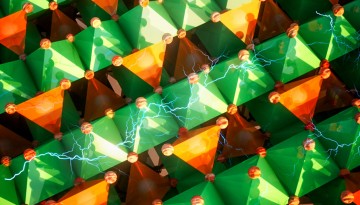
An interdisciplinary team’s work will help researchers who are custom-tailoring the properties of metal oxides in technologies such as lithium ion batteries, fuel cells and electrocatalysis.
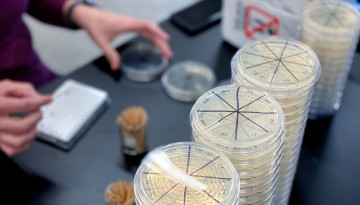
A U.S. Department of Energy agency has awarded $1 million to Cornell researchers, who are using programmed microbes to mine rare-earth minerals used in consumer electronics and advanced renewable energy.