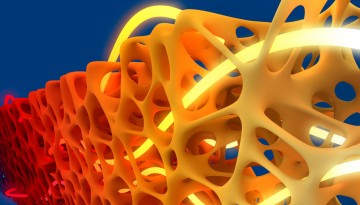
Cornell engineers have developed a new framework that makes the design of stretchy elastomers a modular process, allowing for the mixing and matching of different metals with a single polymer.
Cornell Engineering has established the Lance R. Collins Fellowship, created to support engineering graduate students from traditionally unrepresented populations, as well as honor its former dean of 10 years.
The Braudy Foundation – founded by Bob Braudy ’65, M.Eng. ’66, and his wife, Judi – has committed to funding a second five-year phase of a research collaboration between Cornell and Northern Arizona University.
A Cornell researcher is developing a technique for precise fabrication of porous ceramic materials, opening a new realm of possibilities for their application in industrial and biomedical products.
Cornell systems engineers examined data from a busy New York state food bank and, using a new algorithm, found ways to better allocate food and elevate nutrition in the process.
Researchers successfully engineered E. coli bacteria to produce O-linked glycoproteins – research that will illuminate the complex process of glycosylation and the role that protein-linked glycans play in health and disease.
As scientists prepare to study Martian soil for signs of life, a new worry emerges. Acidic fluids once on Mars’ surface may have destroyed biological evidence hidden within the planet’s iron-rich clays.