Since requesting proposals in April, the Cornell Atkinson Center for Sustainability has awarded approximately $250,000 in rapid-response grants for COVID-19-related Cornell research.
Peter McMahon, assistant professor of applied and engineering physics in the College of Engineering, and Brad Ramshaw, the Dick & Dale Reis Johnson Assistant Professor of physics in the College of Arts and Sciences, have been named CIFAR Azrieli Global Scholars.
Machine learning can assess the effectiveness of mathematical tools used to predict the movements of financial markets, according to new Cornell research.
New York City residents are four times more likely to choose a store where shoppers respect 6 feet of distancing than one where no one is social distancing, according to a Cornell experiment using 3D simulation.
Cornell has secured a U.S. Department of Energy grant, expected to total about $7.2 million, which will fund exploratory research to help verify the feasibility of using a novel geothermal energy system to heat its campus buildings.
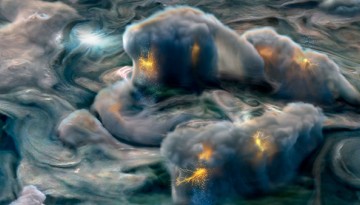
NASA’s Juno spacecraft – closely observing Jupiter – has unexpectedly discovered lightning in the planet’s upper atmosphere, according to a NASA/JPL study, which includes two Cornell researchers.
Cornell’s Art DeGaetano is one of nine scientists to co-author a USDA report to help the nation’s farmers and commercial agricultural managers reduce risk in the face of climate change.
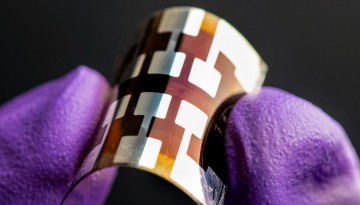
When it comes to the future of solar energy cells, say farewell to silicon, and hello to calcium titanium oxide – the compound mineral better known as perovskite.
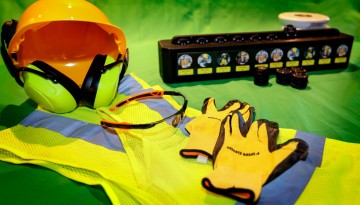
A Cornell-based startup has shifted its platform’s technology in response to the pandemic, ensuring social distancing in the workplace and enabling companies to bring employees back to work safely.