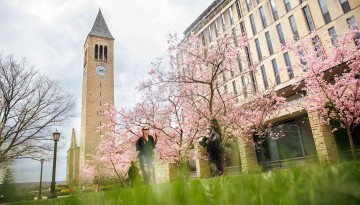
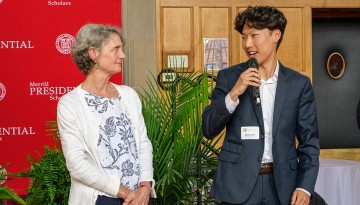
At its May 23 meeting, the Cornell Board of Trustees elected five new trustees and reelected six current trustees to four-year terms. They all join recent alumni- and student-elected trustees.
Scientists have discovered a way to convert fluctuating lasers into remarkably stable beams that defy classical physics, opening new doors for photonic technologies that rely on both high power and high precision.
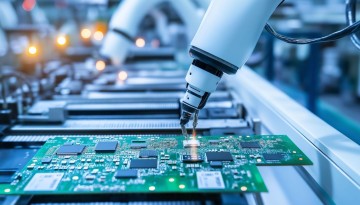
The Cornell Systems Engineering M.Eng. program has developed the Semiconductor, Manufacturing, and Industrial (SEMI) Engineering pathway that features specialized courses for the semiconductor industry, as well as leading-edge approaches in operations, controls, planning and optimization.
During a May 23 ceremony in Statler Auditorium, more than 25 members of Cornell’s Reserve Officers' Training Corps Tri-Service Brigade were commissioned as second lieutenants or ensigns in the Army, Navy, Marines, Air Force and Space Force.
Four Cornell researchers were chosen from a competitive, global application pool to receive Bezos Earth Fund awards to use AI to address climate change and nature loss.
Cornell researchers partner with EDF and industry to study mitigation strategies that could minimize hydrogen emissions and maximize the climate benefit of a growing hydrogen economy.
Cornell faculty are invited to submit proposals for fully funded Thought Summits to spark interdisciplinary collaborations in data science and AI, with applications due June 16.