Researchers developed a low-cost method to produce carbon-free “green” hydrogen via solar-powered electrolysis of seawater, with a helpful byproduct: potable water.
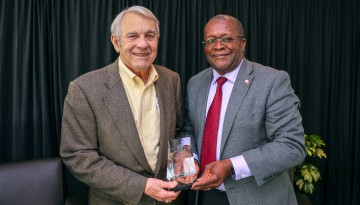
In recognition of his transformative leadership in nanomanufacturing technology, James C. Morgan ’60, MBA ’63, was presented with the Cornell Engineering Distinguished Alumni Award – the college’s highest alumni honor.
Cornell researchers have identified a pair of key neurological mechanisms in the brain – a cell type and receptor – that enable the psychedelic compound’s long-lasting effects.
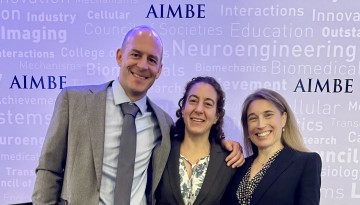
Engineering professors Ilana Brito, Iwijn De Vlaminck and Krystyn Van Vliet were inducted into the American Institute for Medical and Biological Engineering College of Fellows Class of 2025 for contributions to engineering and medicine research.
Cornell scientists launched aluminum particles, each about 20 micrometers in diameter, onto an aluminum surface at speeds of up to 1,337 meters per second – well beyond the speed of sound – and used high-speed cameras to record the impacts.
Cornell researchers are helping to transform portions of Chattanooga’s transit system into a seamless, AI-powered network where buses, shuttles, electric cars and bikes work together to provide the most efficient routes – at the push of a button.
Researchers studying novel traits in organisms and the fundamental understanding of extreme weather are among the five Cornell assistant professors who've received National Science Foundation Faculty Early Career Development Awards.
Cornell Cinema will present a free screening of the documentary “The Accelerator” on April 8 at 6 p.m. Producer David Raubach will attend the screening and participate in a discussion following the film.
Cornell biomedical engineers will use the grant to investigate how osteocytes – specialized cells that respond to and regulate forces within bones – interact with and are impacted by the part of the nervous system that controls rest related involuntary functions such as digestion and heart rate.