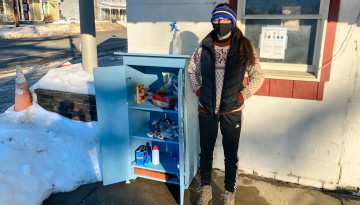
Cornell faculty and students are teaming up with community partners in Tompkins County to address opioid use, increase food security, build a greener construction industry and share stories of Ithaca’s Black history pioneers.
Several faculty members in the Cornell SC Johnson College of Business talk about what key lessons leaders and managers can gain from the experiences of 2020 and apply to 2021 and beyond.
As CCSS fellows, a dozen faculty members representing seven colleges and schools will pursue ambitious research projects on issues ranging from political polarization to environmental justice.
Richard Stup, agricultural workforce specialist, analyzed the key issues facing New York state farmers this year during Dyson's 2021 Agricultural and Food Business Outlook Conference, held virtually Jan. 25.
As New Yorkers emerge from the pandemic’s economic morass, New York Lt. Gov. Kathy Hochul acknowledged a tough path ahead, but shared hope for the state’s future at Cornell’s annual town-gown regional meeting.
Steven Kyle offered his annual projection for the U.S. economy during Dyson’s 2021 Agricultural and Food Business Outlook Conference, held virtually Jan. 25.
A streamlined process for awarding green cards to international STEM doctoral students graduating from U.S. universities could benefit American innovation and competitiveness, according to new research.
As part of its mission to make Cornell a more diverse and inclusive environment for faculty, staff and students, the Presidential Advisors on Diversity and Equity have awarded three grants of $15,000 apiece for 2021 programming.
Grants awarded recently by the Cornell Center for Social Sciences seeded research projects on topics ranging from COVID-19 and policing to clean energy and product design, led by scholars from across the university.