President Martha E. Pollack on Oct. 18 announced the winners of Stephen H. Weiss Awards honoring a sustained record of commitment to the teaching and mentoring of undergraduate students and to undergraduate education.
Using a Packard Fellowship for Science and Engineering from the David and Lucile Packard Foundation, Peter McMahon, assistant professor of applied and engineering physics, aims to harness the power of photonics to build processors for neural networks that are more than 1,000 times more energy efficient.
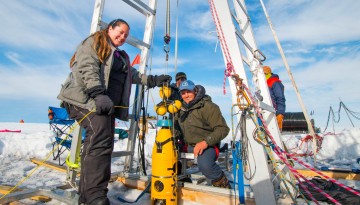
To prep for missions to Jupiter’s icy moon Europa, Britney Schmidt, associate professor of astronomy and earth and atmospheric sciences, is studying Antarctica’s ice and oceans.
Cornell researchers used advanced atomic modeling to explore the ways environment can influence the growth of cracks in alloys such as aluminum and steel – knowledge that could help engineers better predict, and possibly postpone, the failure of structures.
The rocky surface of Earth’s geology may provide a buffer for climate change to absorb excess carbon, according to a new Cornell paper in Global Biogeochemical Cycles.
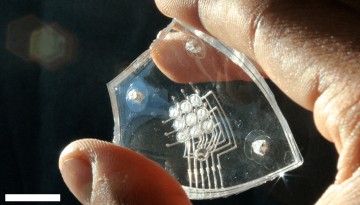
Researchers created a system that uses combustion to inflate silicone membrane “dots,” which could someday serve as a dynamic braille display for electronics.
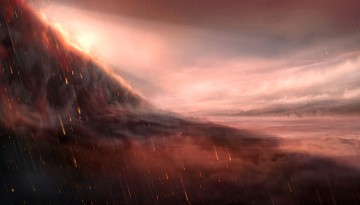
Considered an ultra-hot Jupiter – a place where iron gets vaporized, condenses on the night side and then falls from the sky like rain – the fiery, inferno-like WASP-76b exoplanet may be even more sizzling than scientists had realized.
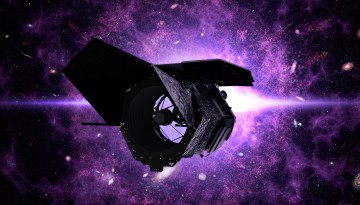
A new Cornell study finds that next-generation telescopes used to see exoplanets could confuse Earth-like planets with other types of planets in the same solar system.
Fumbling to find flashlights during blackouts soon may be a memory, as quantum computing and AI may quickly solve an electric grid’s hiccups so fast, humans may not notice.