Cornell University announced today that it will establish an integrated College of Business with the transformative excellence, scope and scale to cement the university’s position as a world-class center of teaching and research for business management and entrepreneurship.
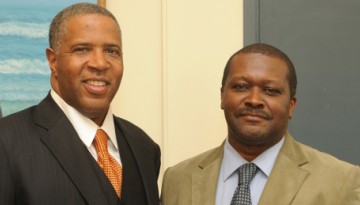
A combined $50 million commitment from Robert F. Smith '85, founder, chairman and CEO of Vista Equity Partners, and the foundation of which he is a founding director will support chemical and biomolecular engineering and African-American and female students in Engineering in Ithaca and at Cornell Tech.
A Cornell team has created the first self-assembled three-dimensional superconductor, another step toward creation of a material that could act as a superconductor at or above room temperature.
The ninth annual Soup & Hope series opened with a talk by Enongo Lumumba-Kasongo ’08, who described her personal journey toward authenticity, letting herself learn how to express and control her emotions in public.
A team led by Cornell professor Grace Xing has created gallium nitride power diodes capable of serving as building blocks for GaN switches, with many possible power and electronics applications.
Four Cornell computer scientists - Ari Juels, Rafael Pass, Thomas Ristenpart and Vitaly Shmatikov - are members of a new cybersecurity, privacy and cryptography reach group at Cornell Tech.
Nearly half of the more than 900 January degree candidates took part in the Dec. 19 recognition ceremony, held before thousands of family and friends in Barton Hall.
A Cornell graduate student employed two-pulse photovoltaic correlation to measure the speed of his team's ultrafast photodetector in research published in Nature Communications, Nov. 17.
Cornell hopes to bring nanotech to young students in the area with the establishment of CNF Ambassadors, an outreach program being run by the Cornell NanoScale Science and Technology Facility.