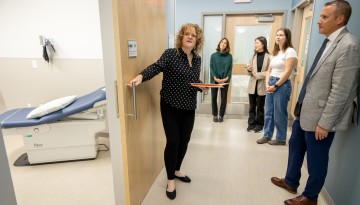
Assisted by Cornell faculty and students, Tompkins County has launched a program to recognize businesses for efforts to welcome patrons across the age spectrum.
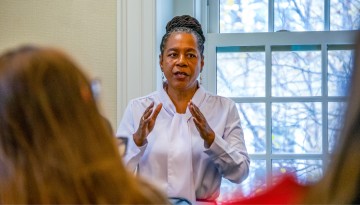
Jennie Joseph, founder and president of Commonsense Childbirth, hosted a public lecture, met with students and faculty, spoke in classes and engaged with the Ithaca community. The visiting scholar initiative honors the legacy of Flemmie Pansy Kittrell, the first Black woman in the U.S. to earn a doctorate in nutrition and the first to receive a Ph.D. in any subject at Cornell.
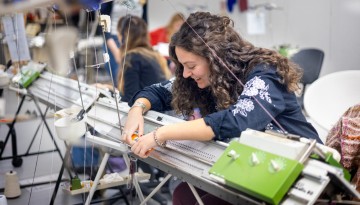
Through a series of visits to regional farms and experimentation with local wool, students in the College of Human Ecology are discovering its idiosyncrasies and charms.
A Cornell research group has developed a cyclodextrin-based fibrous membrane that in lab testing removed approximately 90% of aqueous triclosan, an antibacterial agent that poses a threat to aquatic organisms.
Alumni brothers of Alpha Phi Alpha’s Alpha chapter, founded at Cornell in 1906, unveiled a new leadership institute and student residence, inspired by the fraternity’s founding principles.
A Cornell-led study is among the first to explore Native Americans’ perceptions of stereotypes about them, centering the voices of teenage citizens of the Eastern Band of Cherokee Indians.
Art infusion theory – the idea that displaying art in retail settings can positively impact consumer behavior – can be applied to the metaverse with similar results, a Cornell design researcher has shown.