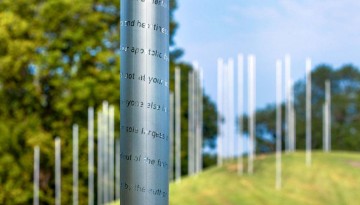
An art installation in Columbus, Indiana, created by two Cornell AAP professors, highlights connections among places around the world named for Christopher Columbus.
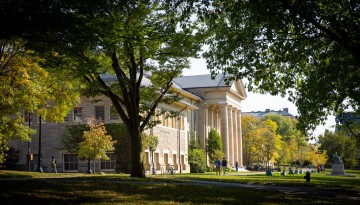
Sonia Rucker, formerly an associate director of diversity and inclusion in the Samuel Curtis Johnson Graduate School of Management, will return to Cornell next month as the associate vice president of the Department of Inclusion and Belonging.
The collaboration will support cross-institutional scientific partnerships between students and faculty at Cornell and N.C. A&T, a historically Black university that produces more African American engineers than any other university in the United States.
Tameka Ellington presented on her new exhibition, which synthesizes research in history, fashion, art and visual culture to reassess the “hair story” of peoples of African descent. The lecture was part of the “Fashion & Social Justice” lecture series.
New York City’s app-based delivery workers regularly face nonpayment or underpayment, unsanitary or unsafe working conditions and the risk of violence, according to a new ILR School report.
Cornell researchers and students are poised to help shed light on the history of St. James A.M.E. Zion Church, the world’s oldest active A.M.E. Zion Church.
Recent doctoral graduates Sadia Shirazi, Ph.D. ’21, and Dexter Lee Thomas, Ph.D. ’20, have been named Emerging Voices Fellows by the American Council of Learned Societies.
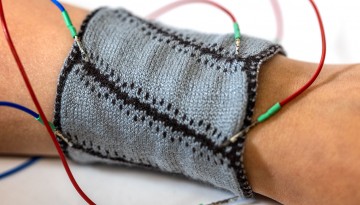
Cindy Hsin-Liu Kao, assistant professor in the College of Human Ecology, uses knitting and weaving techniques to make on-skin devices that express the wearer’s personality.
All this academic year, Cornell Athletics is celebrating 50 years of women’s varsity sports, shining a spotlight on Big Red pioneers, great moments and alumnae whose experience in sports helped propel them to success after graduation and paved the way for future women athletes.