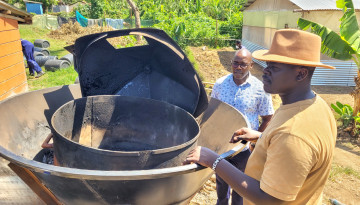
Cornell researchers and Kenyan partners have developed a fertilizer made from human excreta. The product improves soil health and food production, while preventing pollution in informal settlements and the aquatic environment.
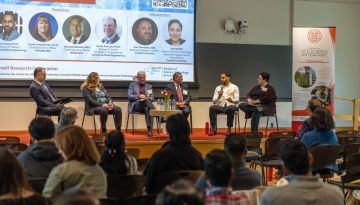
At a daylong event designed to promote academic-industry collaboration, Cornell’s Center for Advanced Technology in Life Science Enterprise cast itself as both a funder of early-stage research and catalyst accelerating connections that move discoveries foward.
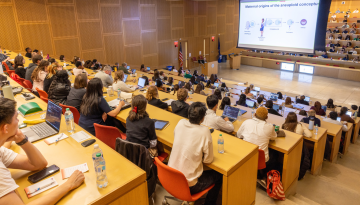
Reproductive health researchers from across the Northeast gathered at Cornell University April 30–May 1 to examine infertility, embryo development and reproductive aging at the 2026 Tri-State Symposium on Reproductive Sciences.
Cornell engineers have developed a robotic collective that behaves less like a machine and more like a material that flows, reshapes and adapts to its environment without centralized control.
Cornell Law School celebrated the Class of 2026 on May 17 as family, friends, faculty and staff gathered at Newman Arena, Bartels Hall for the school’s annual Convocation ceremony.
The event honored graduates from the Class of…
Conditions in e-commerce fulfillment centers are harsher than in traditional warehouses, and Amazon's focus on speedy delivery likely lowers job quality, research finds.
Albert R. “Al” George, the John F. Carr Professor of Mechanical Engineering Emeritus known for the race cars and student teams he championed as well as research and academic leadership, died May 6 in Ithaca. George was 88.
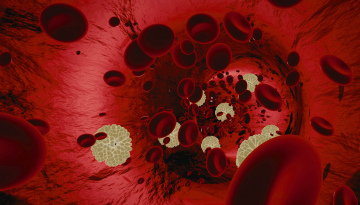
Five innovative immunology research projects have been selected for funding through the Cornell Center for Immunology's 2026 Multidisciplinary Seed Grants.
Complex health challenges require expertise from multiple scientific…