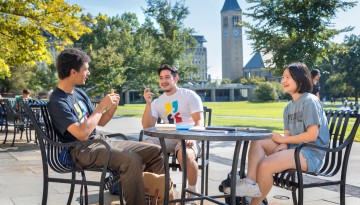
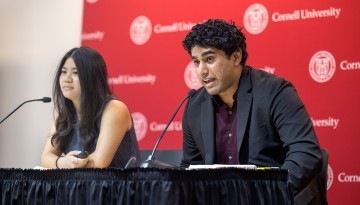
President Martha E. Pollack welcomes students to the 2023-24 academic year and introduces the first universitywide theme year, “The Indispensable Condition: Freedom of Expression at Cornell.”
A new study testing the accuracy of existing methods used to predict the genetic variation that cause infertility found that relying on computational or in vitro experiments alone is insufficient.
To prepare for extreme heat waves around the world, running climate-simulation models that include a new, efficient computing concept may save tens of thousands of lives.
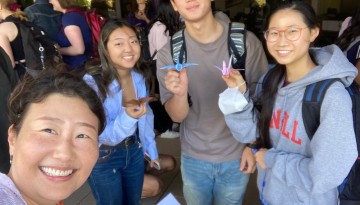
Cornell’s world of opportunities is coming to central campus. Students can take a whirlwind tour through the university’s global offerings at this year’s International Fair on Wednesday, Aug. 30, from 11 a.m. to 1 p.m. on Uris Hall Terrace.
Severe COVID-19 infection triggers changes that affect gene expression in immune system stem cells, causing alterations in the body’s immune response, according to a new study by Weill Cornell Medicine and Jackson Laboratory investigators.
Twelve undergraduates, all ILR majors, took part in the first High Roads Fellowship program to take place in New York City. During the nine-week session, the fellows gained work experience assisting organizations in the NYC region.
Researchers studying the formation of the Earth’s crust and wearable technology for daily-life applications are among those at Cornell who recently received National Science Foundation Faculty Early Career Development Awards.
Heat-retaining buildings and paved surfaces are directly related to a loss in bird diversity, according to a study by scientists at the Cornell Lab of Ornithology and Zhejiang University in China.