Cornell will increase its voluntary, unrestricted contribution to the Ithaca City School District by $150,000 per year, from $500,000 to $650,000 annually, beginning this year, university officials announced.
Cornell legal experts will review the fundamentals of free expression during a Sept. 7 panel discussion kicking off the university’s theme year, “The Indispensable Condition: Freedom of Expression at Cornell.”
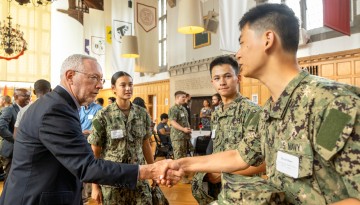
Cornell honored its military community at the second annual Military/Veterans Reception, celebrating achievements including Cornell’s designation as a Purple Heart University, the only Ivy League institution to receive that recognition.
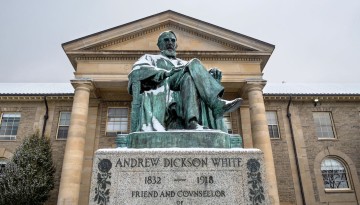
A quantum physicist and an environmental economist have been appointed the newest A.D. White Professors-at-Large, and five returning professors will visit campus this fall.
In two new papers, an international collaboration of researchers including Cornell physicists explain, on the microscopic level, why “Planckian” scattering of electrons occurs in some materials but not in others.
New research involving machine learning determined that the persuasive power of “symbolic status” from virtual badges in online debates has the potential to create an imbalance of power.
From exploring the mechanics of early-stage bone metastasis to analyzing price formation policies in wholesale electricity markets, Cornell Engineering’s Sprout Awards are funding unique research projects with the potential to grow partnerships across Cornell.
Jack Freed, the Frank and Robert Laughlin Professor of Physical Chemistry Emeritus, has received two grants totaling $7.8 million from the National Institutes of Health to use electron-spin resonance for the benefit of public health.