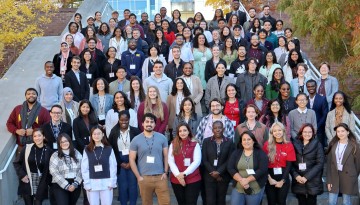
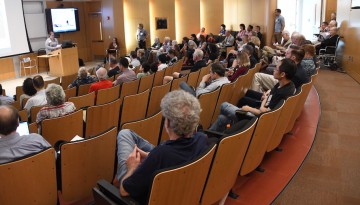
The Consider Cornell programming series, created by the Graduate School Office of Access and Recruitment, seeks to provide guidance to prospective graduate students on the next step in their academic journeys.
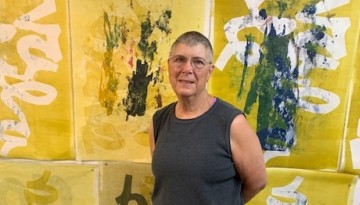
Since retiring from her work as stacks manager at the Cornell Law Library in 2014, Robert has taken full advantage of a benefit awarded to Cornell retirees: Part-time Study, offered by the School of Continuing Education(SCE).
Part-time Study allows Cornell retirees to take up to six credits at Cornell every semester with permission from the instructor, for free.
Researchers are more likely to pen scientific papers with co-authors of the same gender, a pattern not solely due to gender representation across disciplines and time, according to joint research from Cornell and the University of Washington.
Research by J. Nathan Matias, assistant professor of communication in CALS, found that Reddit community members who fact-checked suspect stories led to those stories being dropped in the website’s rankings.
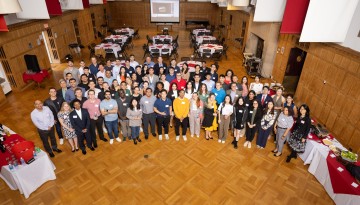
The Master of Science in Business Analytics (MSBA) degree program from Cornell's Samuel Curtis Johnson Graduate School of Management recently welcomed 69 students to campus for a weeklong residency in Ithaca, New York.
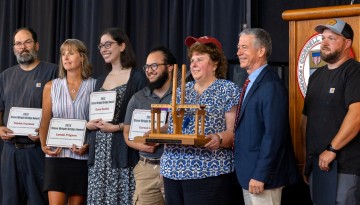
The Division of Facilities and Campus Services met July 26 to commend and award their hard-working employees who keep the students, faculty and staff on campus safe, productive and successful.
Weill Cornell Medicine associate professor Gregory F. Sonnenberg has been awarded a five-year, $3.26 million grant from the National Institutes of Health to investigate the underlying mechanisms of inflammatory bowel disease.
A multi-institution team led by a Weill Cornell Medicine scientist has been approved for $30 million in funding from the Patient-Centered Outcomes Research Institute to study heart procedure outcomes in underrepresented groups.