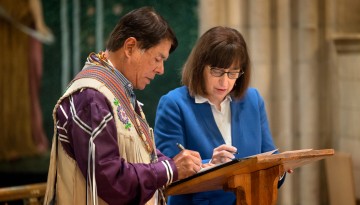
With apologies for causing harm and to right a wrong of history, Cornell returned ancestral remains that were kept on campus for six decades to the Oneida Indian Nation on Feb. 21.
Cornell researchers discovered that colors can help quantify the way energy moves through a specific type of crystal, in which light-sensitive molecules are arranged.
Karen Vogtmann is among 120 members and 30 international members who were elected in 2022, in recognition of their distinguished and continuing achievements in original research.
Assistant professor Amal El-Ghazaly received an NSF CAREER Award for research that could ultimately make next-generation wireless systems more accessible worldwide.
Sophie Lewis will offer a deep dive into the history of radical movements and explore family abolition, which she characterizes as a turning away from the privatization of care.
Current instrumentation being sent to Mars to collect and analyze evidence of ancient life on the red planet might not be sensitive enough to make accurate assessments, according to an international research team co-led by a Cornell astronomer.
Strike numbers rose in 2022, reflecting a trend of more U.S. work stoppages in recent years by workers and activists in the labor movement, according to a report published Feb. 21 by the ILR School.
Seven management doctoral students have received the 2022 Byron E. Grote, M.S. ’77, Ph.D. ’81, Johnson Professional Scholarship, which will support them in making progress with their research at Cornell.