An international team of more than 300 scientists has created the first image of the supermassive black hole at the center of our Milky Way Galaxy. Cornell contributors included Shami Chatterjee and James Cordes from the Department of Astronomy.
The College of Arts and Sciences awarded $1.25 million in grants to faculty members pursuing critical developments in areas ranging from quantum materials to sustainable technologies.
On May 13, a panel of Ukrainian experts will converge at Cornell for a hybrid event to discuss the civil and economic upheaval in their country. The event “Ukraine: War, Economy, Path to Rebuilding” features a panel of Ukrainian government officials, academics and business experts with insights into the state of the economy and postwar plans.
A Cornell study found that still images of models in online retail ads had statistically lighter skin tones than those in videos of the same product and model. They also found evidence of “tokenism” – one model who was considerably darker-skinned than the others.
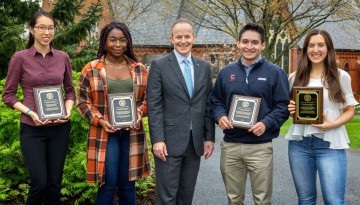
Four students have received the 2022 Cornell Campus-Community Leadership Award, an annual honor given by the Division of University Relations to graduating seniors who have shown exceptional town-gown leadership and innovation.
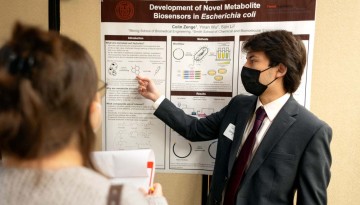
The Cornell Undergraduate Research Board student-run Spring Symposium, held May 4, provided a space for undergraduates to present scholarly research in front of an audience.