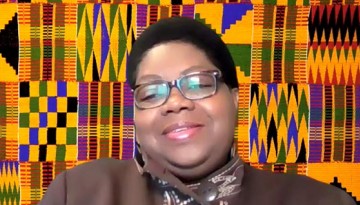
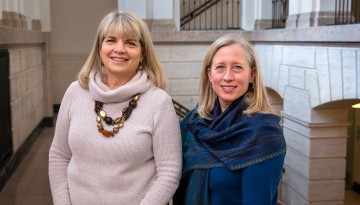
The 10th annual Cornell Town-Gown Awards – known as the TOGOs – took on the warmth of camaraderie as three community partners were recognized in a virtual event Nov. 21 for their neighborly teamwork.
In the second “Racism in America” webinar, presented Nov. 19 by the College of Arts and Sciences, a panel of four Cornell faculty experts discussed discrepancies in education and housing.
A multi-institution team co-led by a Cornell researcher has identified the genetic mechanisms that enable the production of a deadly toxin called Victorin – the causal agent for Victoria blight of oats, a disease that wiped out oat crops in the U.S. in the 1940s.
Cornell Students for Black Lives, a coalition of student organizations, helped raise more than $100,000 in support of racial justice. Funds from the campaign were recently distributed to groups both locally and nationally.
The large Cornell-designed telescopic ‘ear’ at Arecibo, Puerto Rico, which listened for the enlightening crackle of the cosmos for nearly six decades, now hears silence.
A new grant will enable the Bank of America Institute for Women's Entrepreneurship at Cornell to enroll another 30,000 students in its online certificate program, more than doubling total enrollment while continuing to make diversity a priority.
In his new book, “The Early Martyr Narratives: Neither Authentic Accounts nor Forgeries,” humanities professor Éric Rebillard argues that martyr narratives are “fluid texts,” written anonymously, but not as literal historical documents.
President Martha E. Pollack urged continued flexibility and a shared sense of responsibility among the Cornell community as she outlined campus plans for the spring semester.
In the sixth Cornell Leadership Sessions video, President Martha E. Pollack and Dr. Gary Koretzky, vice provost for academic integration, discuss the recent cluster of cases on the Ithaca campus, the need for continued vigilance and plans for a hybrid spring semester.