March 12 will mark Cornell’s sixth Giving Day, a 24-hour fundraising celebration in which Cornellians come together to support the areas they care most deeply about – and engage in some friendly competition.
The Collegetown Small Business Alliance – in partnership with Cornell, the city of Ithaca and others – has created a new light pole banner program in Collegetown. The banners were designed by Sheri Guo ’22.
Most birth control options rely on women to manage, but promising Cornell research from the lab of Paula Cohen, professor of genetics in the College of Veterinary Medicine, may be changing the game by tackling male contraception.
In recent years, researchers in the lab of Hening Lin discovered enzymes that remove chemical modifications – “codes” used for cell signaling – from proteins.
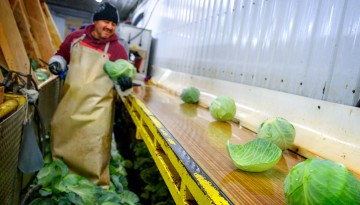
Trained Cornell Cooperative Extension agents teamed with New York State Department of Agriculture and Markets personnel across the state to offer free and confidential on-farm readiness reviews to insure that farmers can meet new produce safety standards.
Soil scientist Johannes Lehmann and Nathaniel Stern ’99 collaborated on experimental pyrolysis techniques to “age” modern technology and media – cellphones, laptops, tablets, floppy disks – for Stern’s art exhibit in Milwaukee.
The “Leadership Skills for Success” workshop, March 24-25 in the Stocking Hall Conference Center, promises to help participants develop the critical communication and supervisory skills needed to build and lead their teams.
Recyclable plastic containers with the No. 2 designation could become even more popular for manufacturers as plastic milk jugs, dish soap and shampoo bottles may soon get an environmental makeover.
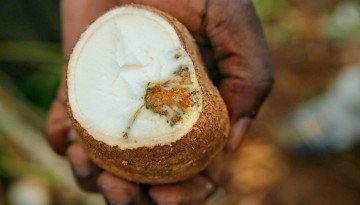
Alfred Ozimati, Ph.D. ’18, is breeding the latest in disease-resistant cassava that meets the needs of subsistence farmers, thanks to the NextGen Cassava project run by Cornell.