Renerva, a medical startup developing an injectable gel to speed the healing of damaged nerves and creating a nerve-graft product, has joined Cornell’s McGovern Center.
The university reaffirmed its commitment to serving the community by extending its longtime contribution to Tompkins County Public Library, pledging $100,000 over the next five years.
Paul Ginsparg, Ph.D. ’81, professor of physics and information science, is the recipient of the American Institute of Physics 2020 Karl Taylor Compton Medal for Leadership in Physics.
Dmitry Savransky, assistant professor of mechanical and aerospace engineering, is a co-investigator on a $2.6 million National Science Foundation grant aimed at the discovery of relatively young, large exoplanets.
Soraya Nadia McDonald, cultural critic for The Undefeated, a website exploring the intersection of race, sports and culture, has been named winner of the 2019-20 Nathan Award for Dramatic Criticism.
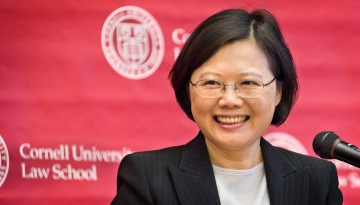
As president of Taiwan, Tsai Ing-wen, LL.M. ’80, has presided over one of the most successful efforts in the world at containing COVID-19. In this Q&A, she discusses her approach to leadership and Taiwan’s success.
Kate Manne, associate professor of philosophy in the College of Arts and Sciences, has won the 2019 American Philosophical Association’s Book Prize for her first book, “Down Girl: The Logic of Misogyny.”