Weill Cornell Medicine scientists have uncovered the first evidence that astrocyte receptors can trigger opposite effects on cognitive function in males and females. The findings point to astrocytes as contributors to sex-specific brain mechanisms.
Tapomayukh “Tapo” Bhattacharjee plans to develop a robot-assisted system that will not only prepare meals for people with severe mobility limitations but also feed them and clean their table afterward.
Assisted by Cornell faculty and students, Tompkins County has launched a program to recognize businesses for efforts to welcome patrons across the age spectrum.
When a dune in Sodus Point, New York - built in 2021 to prevent flooding - grew so high some residents lost their view of the water, NY Sea Grant stepped in to ease tensions and facilitate a new maintenance plan.
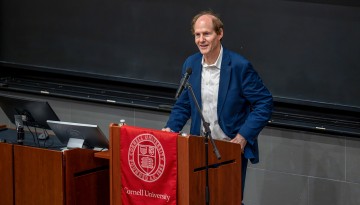
First Amendment law and trying to “figure out what’s true” are guiding principles for free speech on college campuses, said constitutional scholar Cass R. Sunstein in the annual Milton Konvitz Memorial Lecture on Oct. 30.
Klarman Fellow Kendall Artz wants to push beyond the assumption – one replicated by scholars – that company rosters and state records hold all there is to know about racial expression.
The 2025 Cornell Survey of Sexual Assault and Related Misconduct showed a rise in the number of students who said they experienced nonconsensual sexual contact, as the percentage of students who responded to the biennial survey dropped by more than half.