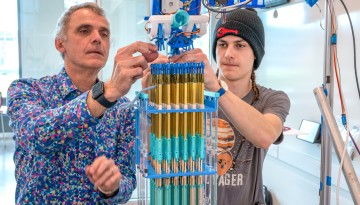
At 15, Tobias Weinberg lost the ability to speak - now as a Ph.D. student at Cornell Tech, he's using AI to improve the technologies he and others with speech disabilities rely on to communicate.
The new four-year program — one of only three wildlife-focused veterinary residencies in North America to be approved by the American College of Zoological Medicine (ACZM) — responds to a growing need for veterinarians trained in free-ranging wildlife health, a discipline that bridges individual patient care and population-level management.
Cornell’s Food Systems and Global Change group coordinated a special issue of The Lancet Planetary Health, which advocates for transforming food systems to ensure sustainability and healthy diets for everyone.
Stacey Langwick, associate professor of anthropology in the College of Arts & Sciences, will speaking on "Healing in a Toxic World: Reimagining the Times and Spaces of the Therapeutic."
A multicollege team has developed a prototype of a knitting machine that creates solid, knitted shapes, adding stitches in any direction so users can construct a wide variety of shapes and add stiffness to different parts of the object.
Biodiversity startups raise less capital than other startups but attract a broader coalition of investors, according to a new analysis that used machine learning to sift through venture capital databases.
People say they would feel worse telling others about their charitable acts than if they kept the news to themselves, or told others about their personal achievements, the study found.
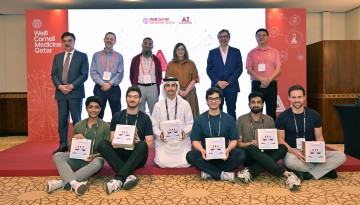
Weill Cornell Medicine-Qatar hosted its first AI Hackathon – a collaborative, interdisciplinary event that brought together medical and computer science students to develop AI-driven solutions for pressing clinical challenges.
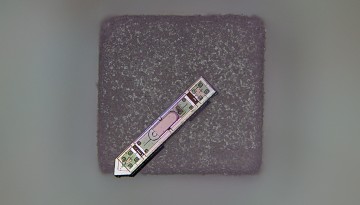
Cornell researchers and collaborators have developed a neural implant so small that it can rest on a grain of salt, yet it can wirelessly transmit brain activity data in a living animal for more than a year.