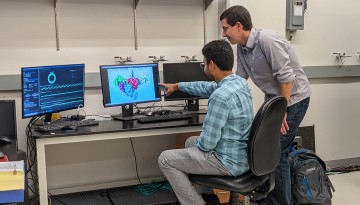
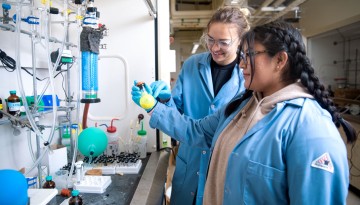
The new findings published in Science capture never-before-recorded stages of a molecular construction process, with implications for future pharmaceutical development.
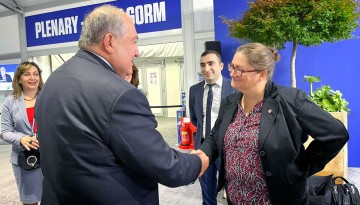
Working with the Armenian delegation at COP26, Allison Chatrchyan aims to shape U.N. agriculture policy to reduce greenhouse gas emissions and increase carbon sequestration.
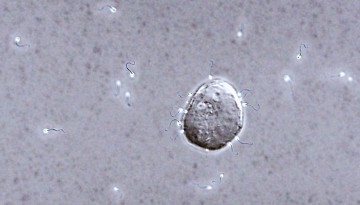
A new study by Cornell researchers reveals how sperm change their swimming patterns to navigate to the egg, shifting from a symmetrical motion that moves the sperm in a straight path to an asymmetrical one that promotes more circular swimming.
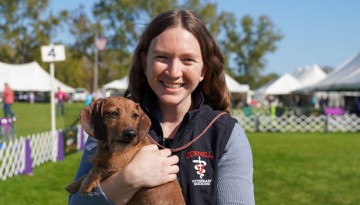
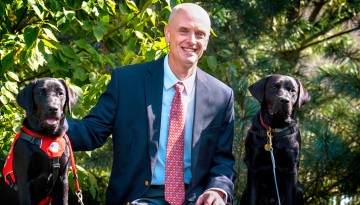
The Wine Country Circuit is one of the largest dog show circuits in the country and a unique learning opportunity for Cornell veterinary students, who shadowed mentors, exhibitors and field veterinarians Oct. 2.
The Nexus Scholars program, funded by nearly $5 million in philanthropic support, will help undergraduates working on research projects with faculty members over the summer.
The College of Veterinary Medicine launched its new Department of Public and Ecosystem Health Oct. 25 after extensive campus consultation. This is the college’s sixth academic department and its first new department in more than 20 years.
Two renowned biologists, May Berenbaum, Ph.D. ’80, and Ellen Rothenberg, have been appointed to six-year terms as Andrew Dickson White Professors-at-Large.
The faculty recipients of the 2021 Innovative Teaching and Learning Awards will use grants of up to $20,000 to explore new teaching technologies and strategies to enhance the student learning environment across campus.
Registration is now open for Cornell's Winter Session 2022. You can choose from a wide range of online courses taught by Cornell faculty during the three-week period from Jan. 3-21. Enrollment is open to anyone interested in taking a class—from undergrads and high school students to alumni and any motivated adult.